



Ethena's fee switch turns USDe revenue into ENA buybacks, but only once USDe supply crosses $7.5B. At $4.56B today, the core USDe book buys nothing yet. We size what it could buy at each supply level, and what it would take to get there.
The Third Buyback Engine
When ENA holders approved the fee switch in September, the Ethena Foundation named three business lines whose net revenue would fund ENA buybacks: USDe savings, Whitelabel stablecoins and Ethena Pay.
This series takes each engine in turn. We covered Ethena Pay first, then Whitelabel; this piece covers the last and largest, the core USDe book.
It is also the engine that decides when the others count. Buybacks start only when the 14-day average of USDe supply crosses $7.5B, and the share of revenue taken steps up again at $10B, $15B and $20B. With USDe at $4.56B, every pillar’s contribution waits on this one.
We also explain how the fee switch converts USDe revenue into ENA purchases, sizes the buyback in bear, base and bull cases, and assesses the two levers most likely to move supply: distribution and the basis trade.
Key Findings
Core USDe is the only pillar large enough to move the ENA bid, and the fee-switch ladder turns it into one question: can Ethena regrow the book from $4.56B to $10B and beyond without token incentives?
The size of the prize. At $10B the core book buys about $46M of ENA a year; at the 2025 peak of $15B, about $103–128M.
The levers. Distribution sets the floor, the basis trade sets the slope, and Pay, Whitelabel and the rest of the suite feed the same 14-day supply average.
Growth comes first. Guy Young has called buybacks “useful as a signalling mechanism” and said reinvesting in growth matters more at Ethena’s size.
The price already leans on it. ENA’s market cap implies a book near $15B.
How The Fee Switch Works
The bid comes from a slice of gross revenue, set by where the 14-day supply average sits on the ladder.
The chain runs in four steps:
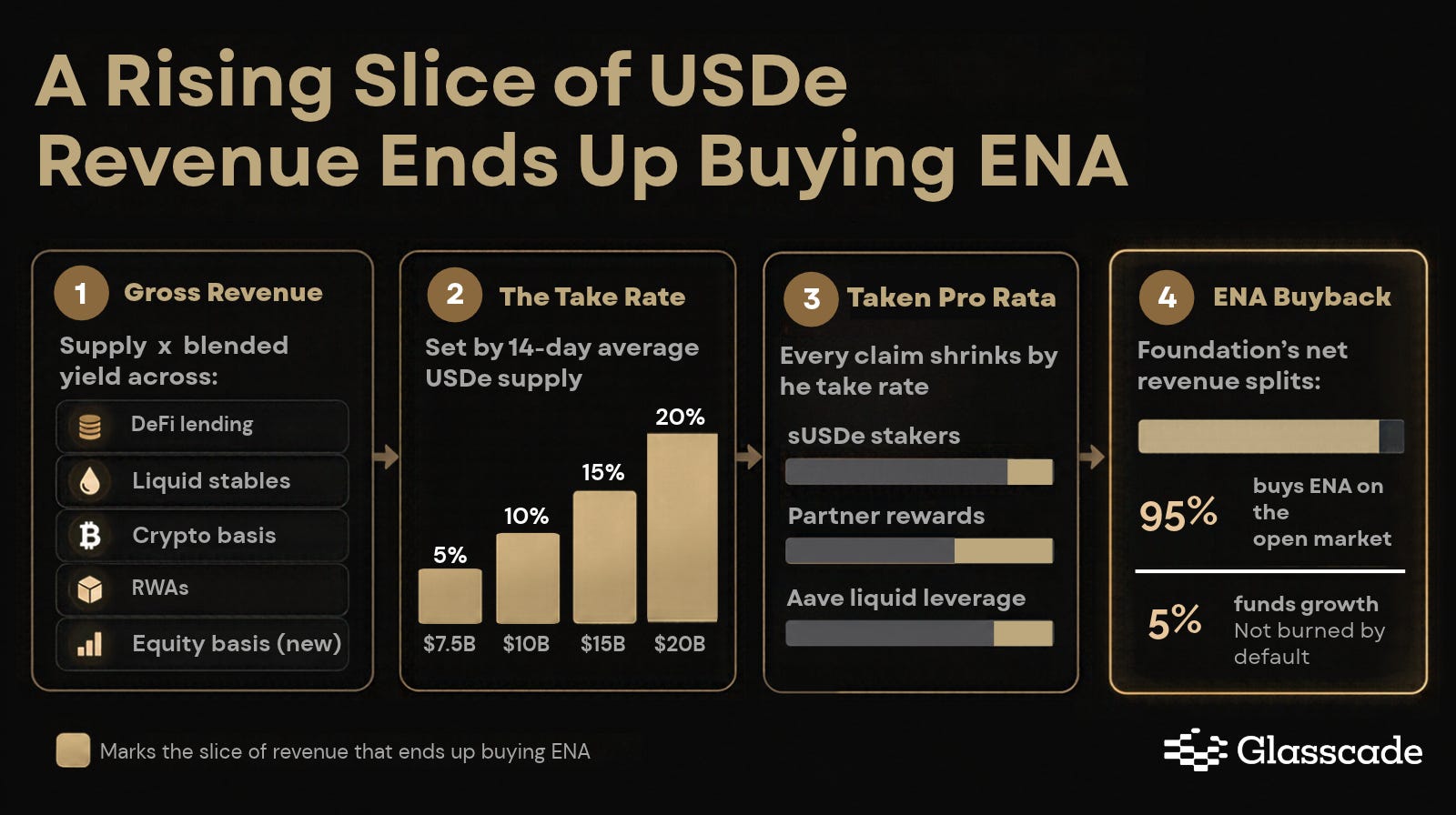
1) The book earns gross revenue → Supply x blended yield from lending, liquid stables, crypto basis, RWAs and (newly) equity basis
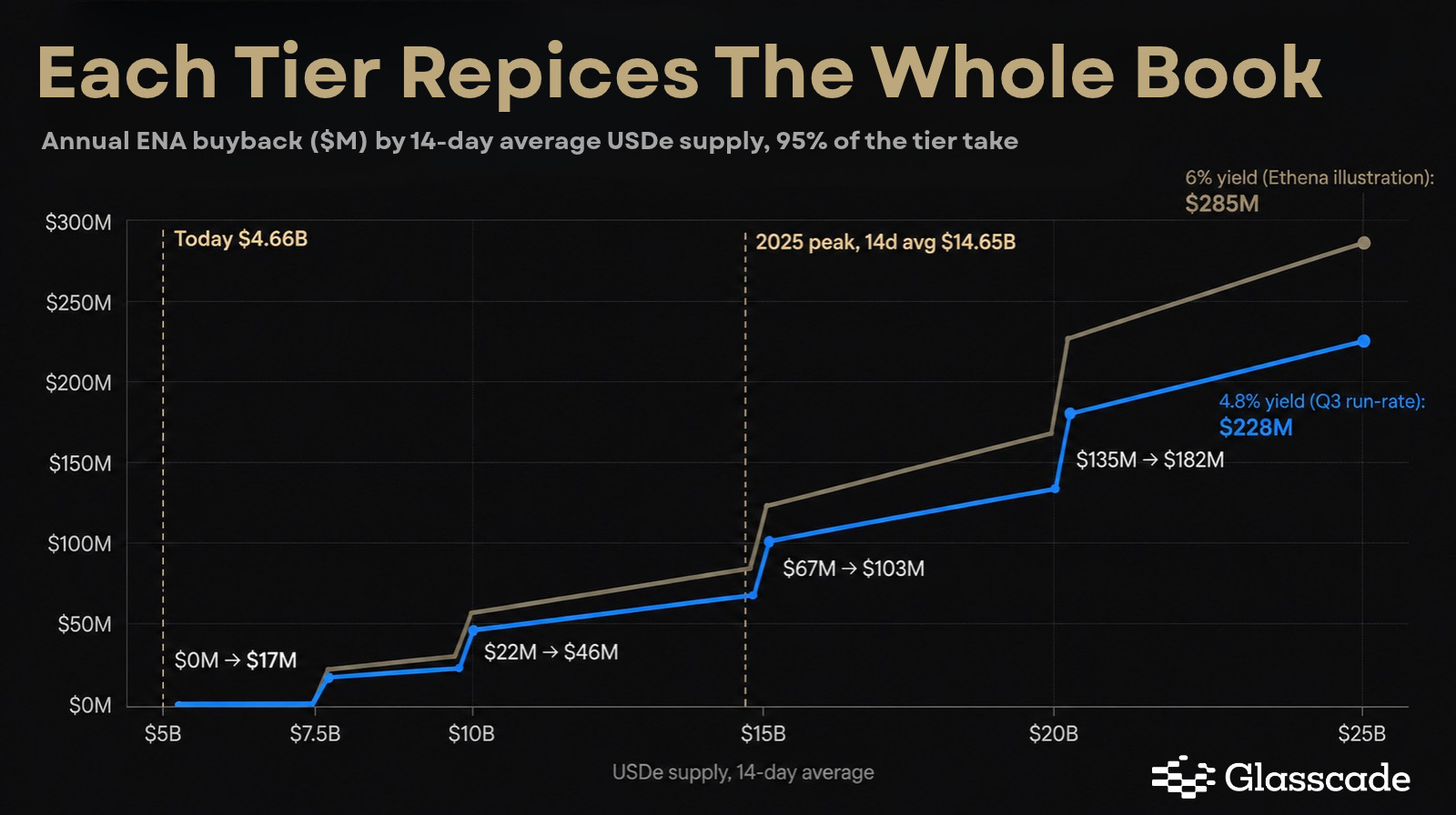
2) The ladder sets the take → 5% of gross revenue at $7.5B, 10% at $10B, 15% at $15B, 20% at $20B.
3) The take is pro-rata → It comes off every current claim on revenue in proportion: sUSDe stakers, partner rewards and the Aave liquid leverage program each shrink by the take rate.
4) 95% of the Foundation’s net revenue buys ENA on the open market and the other 5% funds growth. Purchased ENA is not burned unless a later vote says so.
In plain terms, the buyback is roughly:
Supply x Yield x the tier’s take x 0.95
Two features follow:
Convexity at each tier. The rate applies to the whole book, so the last dollar that crosses a threshold re-prices every dollar below it.
A cost to the product. A 10% take trims a 4.9% sUSDe APY to about 4.4%. Blockworks found the sUSDe-to-sUSDS yield ratio predicts 30-day supply growth, so the take slightly slows the very variable that triggers it.
The USDe Book Today
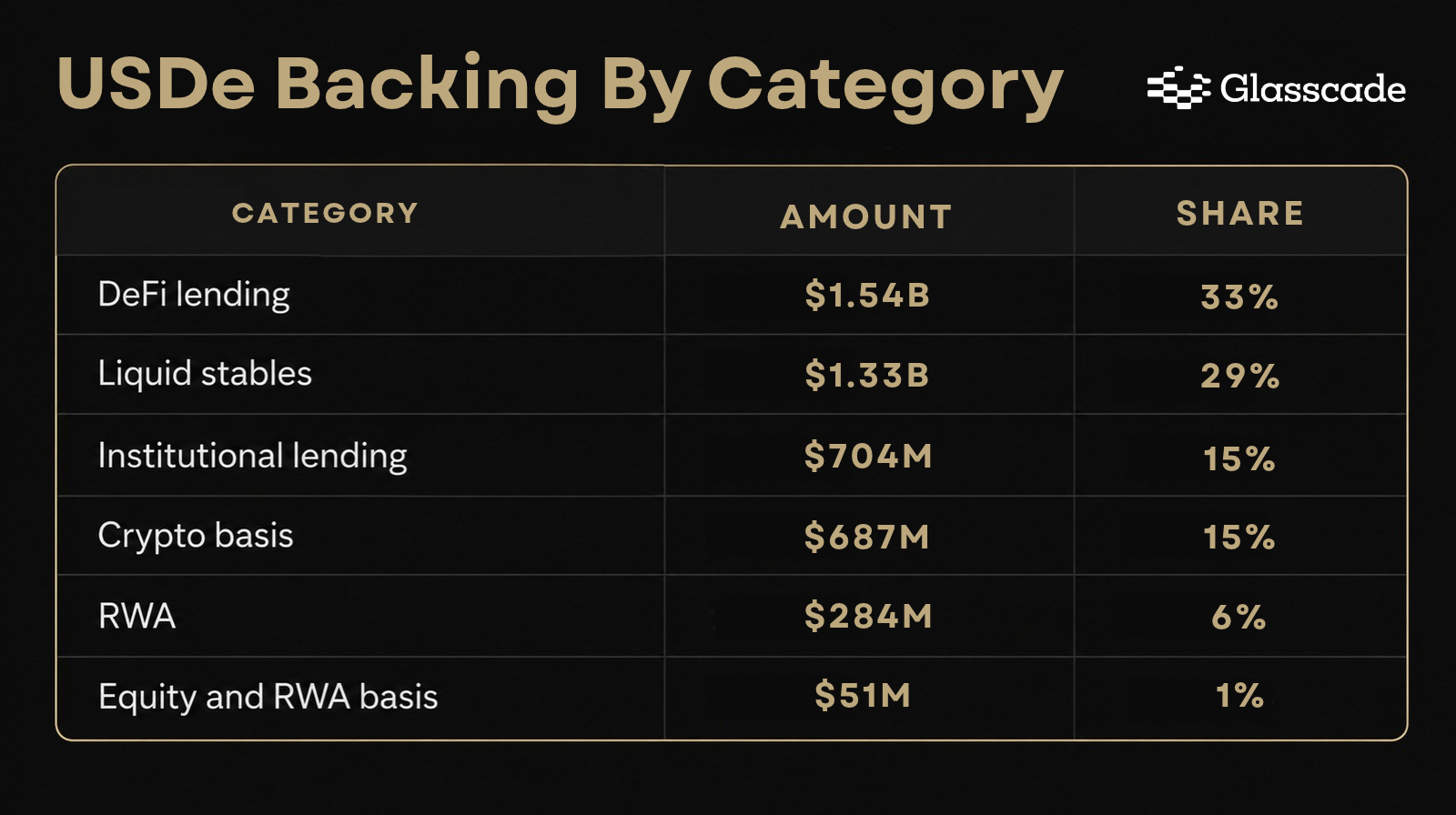
USDe is $2.94B (64%) short of the first tier (i.e. $7.5B) and has drifted lower since incentives ended; yield, solvency and distribution are in better shape than supply.
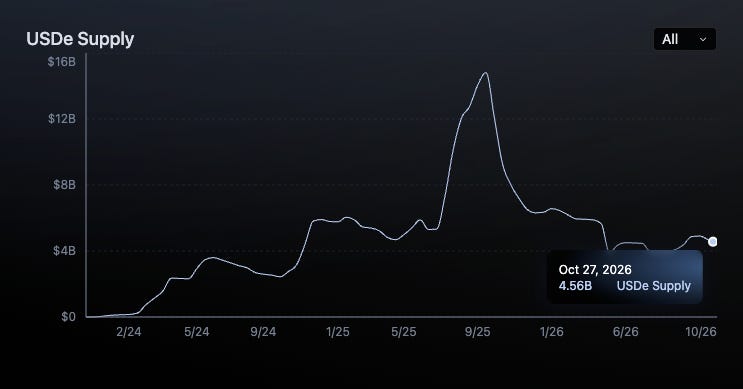
USDe today: supply, yield and revenue
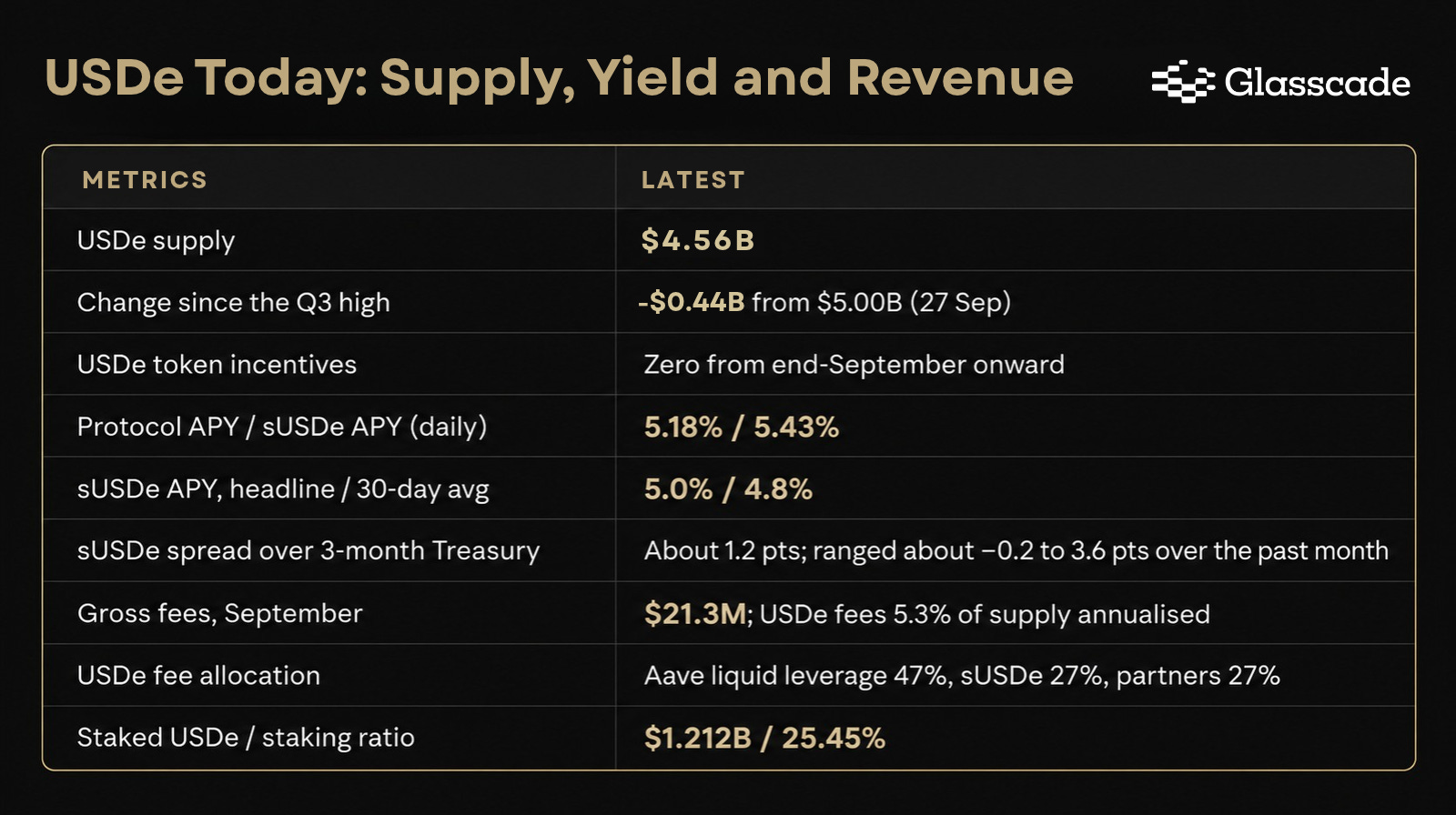
USDe backing by category
That backing fully covers the book: on 27 October the protocol backing ratio stood at 101.42%, with the Reserve Fund at $62.05M against a recommended $45.7M (Q3 update). About $896M of stablecoins was also on hand for immediate redemption, roughly a fifth of supply.
Funding Inputs
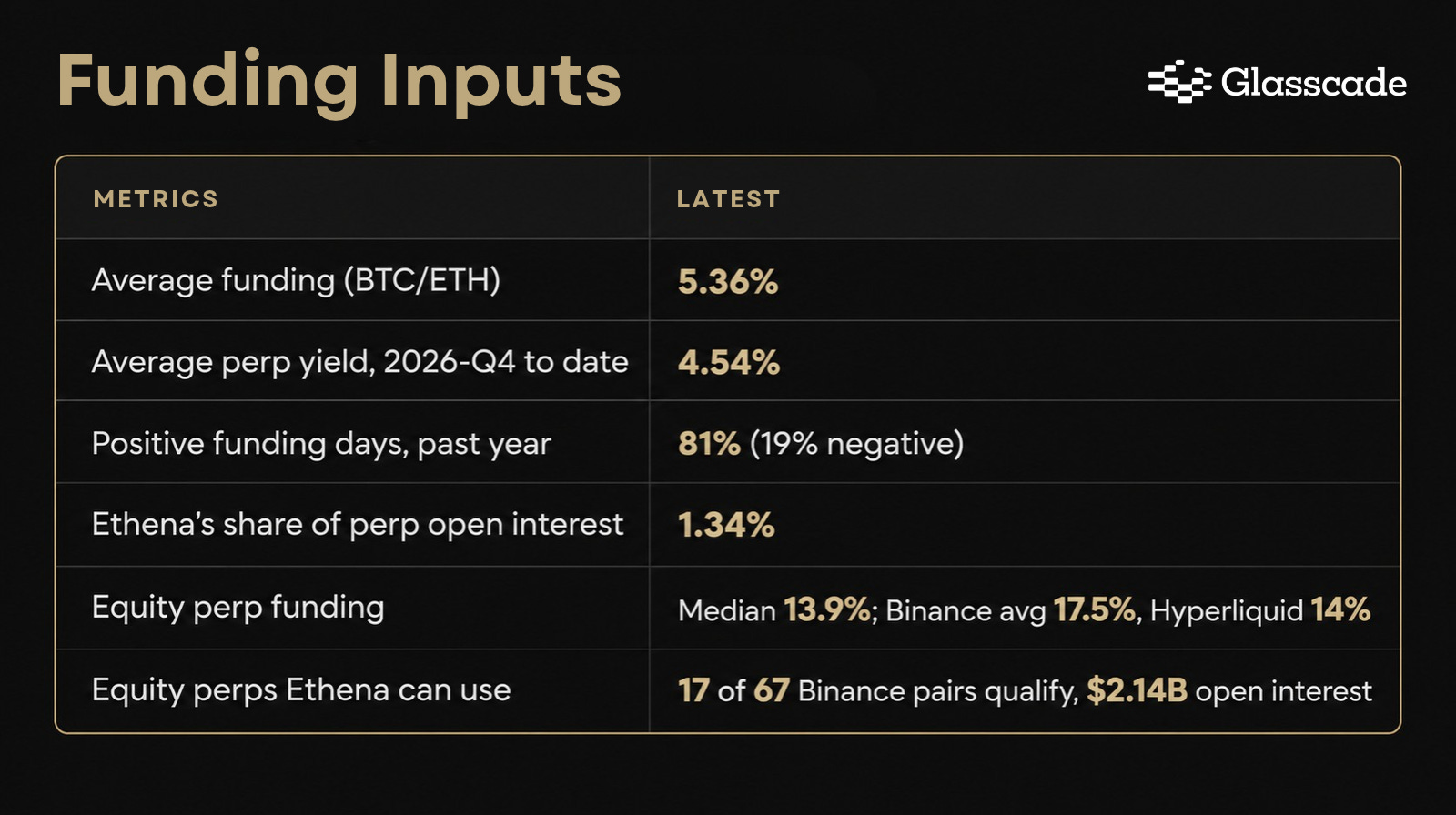
Three readings carry into the model:
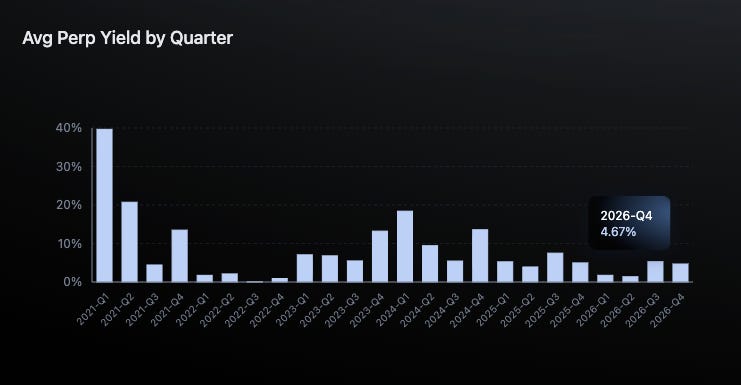
The yield engine is recovering → Funding at 5.36% and protocol APY above 5% are well above the 2026-Q1 and Q2 averages on Ethena’s own quarterly chart.
Supply has not followed yet → The first month without incentives took the book down about 7%.
Crypto basis capacity is not the constraint → Ethena’s hedges are 1.34% of perp open interest; the binding input is the funding rate, not room to trade. Equity basis is only $51M so far.
Growth Lever: Distribution
The rails are built and now the USDe penetration is the gap.
USDe sits inside platforms with several hundred million users, with the balances Ethena lists there total about $1.7B, roughly $1-4 per user. This is the channel Guy Young leans on: he argues builders overlook centralised exchanges, and that Ethena works best as the back end of platforms people already use.
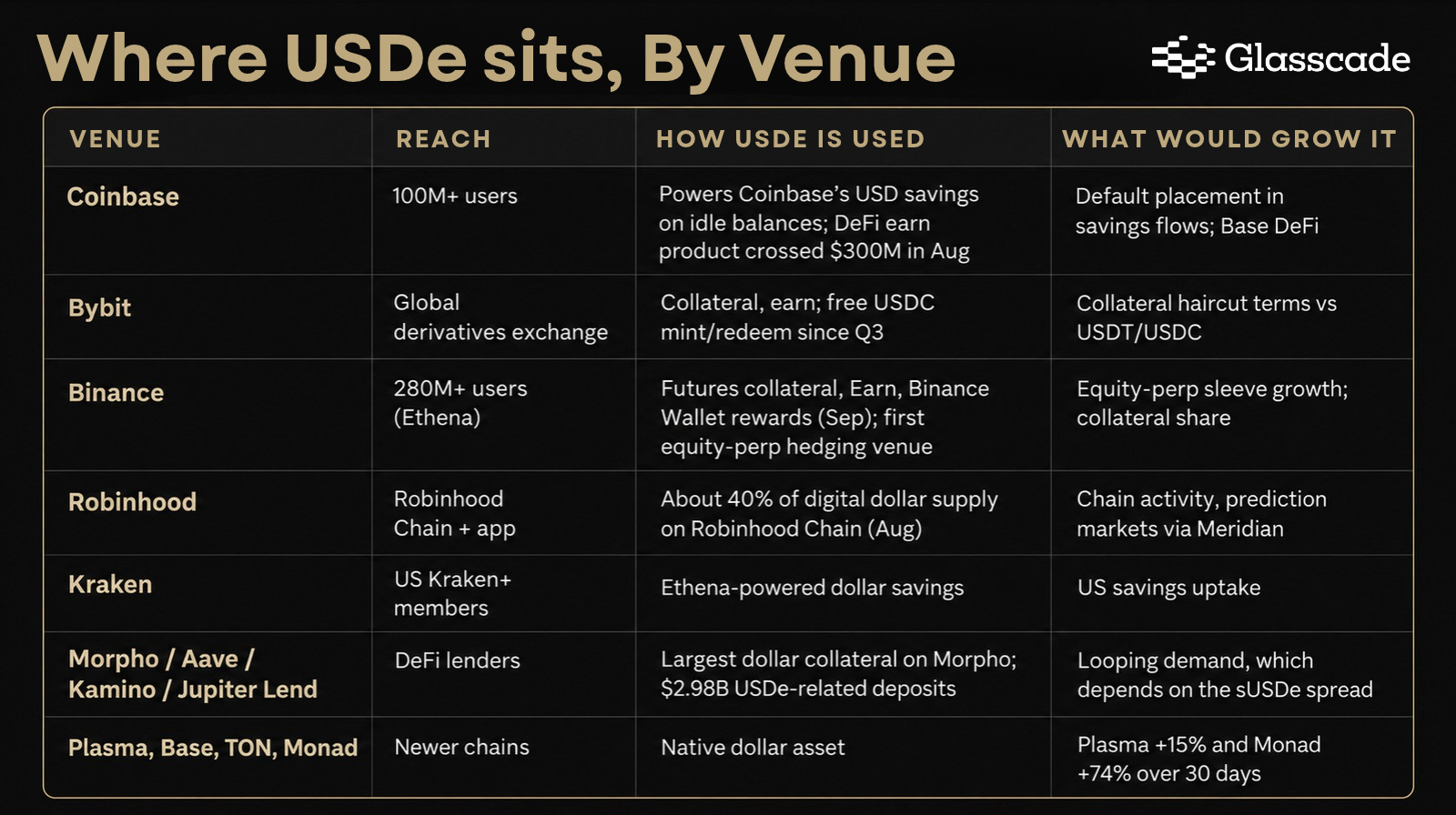
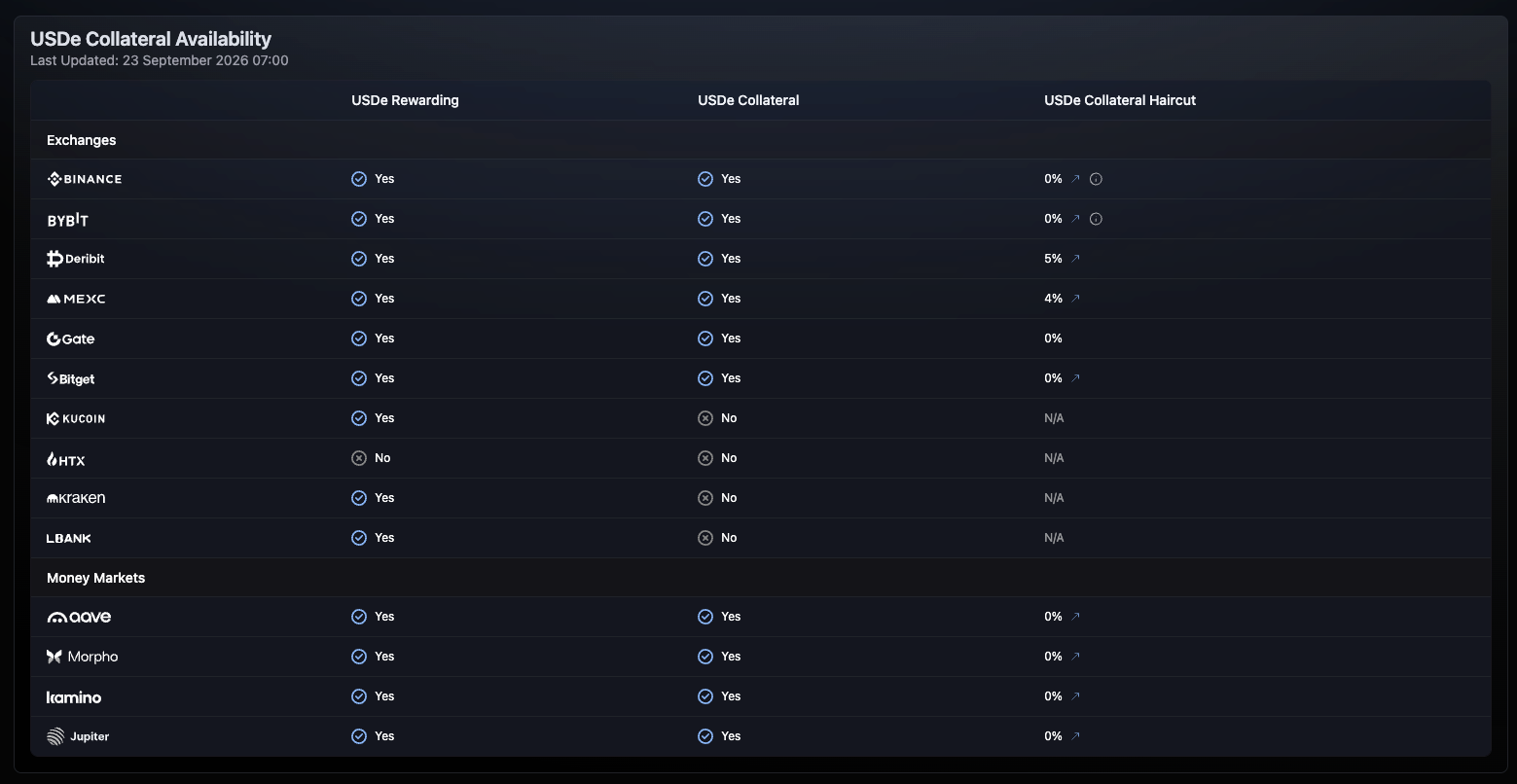
Collateral status is where distribution turns into sticky balances. USDe counts as 0% haircut collateral at Binance, Bybit, Gate, Bitget and the four main money markets, but Kraken, KuCoin and LBank only offer rewards.
Each of those becoming a collateral venue is a concrete, observable lever.
What this means for the buyback:
The gap is about $5.4B to $10B → Listed exchange balances would need to roughly quadruple to close it alone, so it has to come from several venues at once.
Coinbase is the largest untested lever → At $392M across 100M+ users, even $10 per user would add about $0.6B, a fifth of the way to the first tier.
Lending venues follow the spread → Morpho and Aave balances are mostly loops on sUSDe yield - these arrive fast when the spread widens and leave fast when it closes.
Growth Lever: Basis Trade
A better basis trade helps the buyback twice:
Directly, by raising revenue per dollar of USDe
Indirectly, by widening the sUSDe spread that pulls new supply in
Between these, the second effect is the larger one.
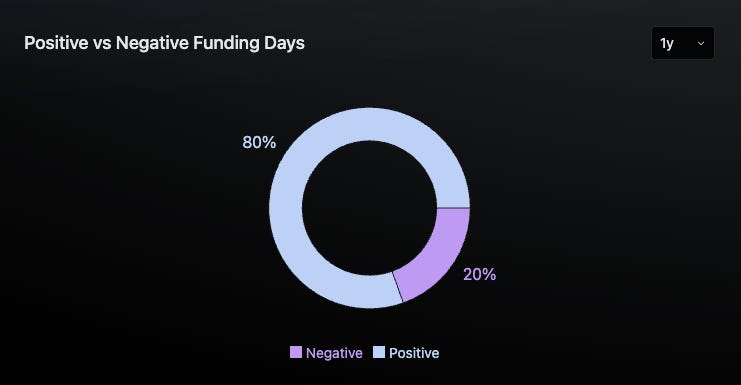
Ethena’s own quarterly series shows how far the engine has swung: average perp yield ran at 13-18% in the strongest 2024 quarters, fell to low single digits in the first half of 2026, and is 4.54% so far in Q4. Funding was positive on 81% of days over the past year.
The direct effect is modest.
We calculated the gross yield under four illustrative backing mixes (cash and lending held at 4.5%; sleeve sizes and rates are assumptions), with the annual buyback at each tier:
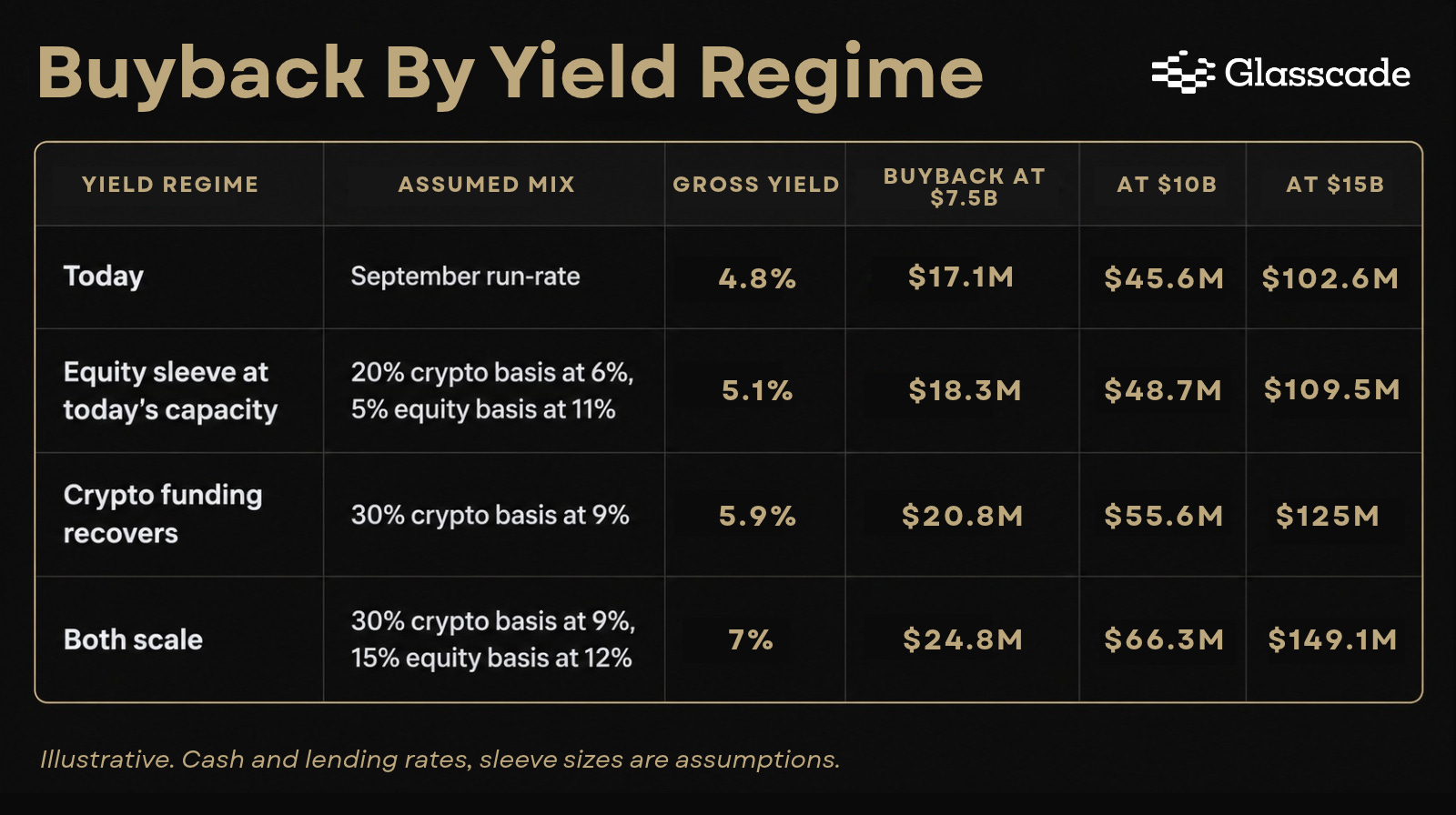
Even the strongest regime lifts the buyback by under half at a fixed supply.
Crossing from $9.9B to $10B adds more ($23M) than moving yield from 4.8% to 7.0% at $10B ($21M).
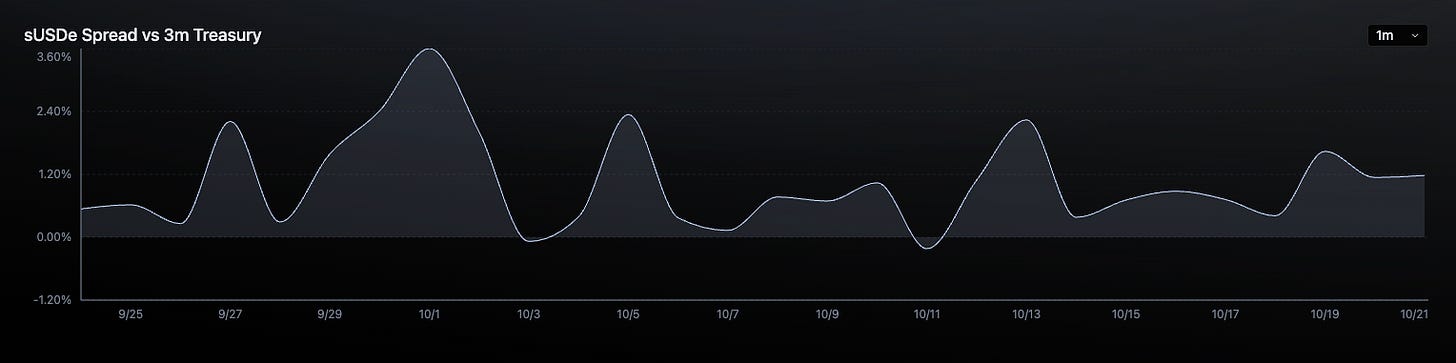
The supply effect is where yield pays.
New USDe follows the spread savers can see. Over the past month sUSDe’s premium to the 3-month Treasury swung from slightly negative to 3.6 points, and sits near 1.2 now.
Ethena’s own charts showed how USDe’s expansions came in the high-yield quarters, and the 2026 slump in the low ones. If gross yield moved from 4.8% to 5.9%, sUSDe would pay about 6.1%, roughly double today’s spread over Treasuries - a condition under which USDe has grown before.
Equity perps change the shape, not yet the size. The equity and RWA basis sleeve is $51M, about 1% of backing.
The appeal is steadier funding → long-run demand for leveraged equity exposure kept equity funding positive on 94-97% of days, and it barely moved with BTC funding.
Capacity is the limit → Qualifying Binance pairs held $2.14B of open interest in August, so a 5% sleeve on a $10B book would already be a quarter of it. Equity OI grew about tenfold from March to August.
The direction is set → Ethena expects RWA perps to overtake crypto derivatives in USDe’s backing within 12–24 months, a widening of its market from about $2.5T to about $150T. On a larger book, that is what makes a 6-7% yield durable rather than a cyclical move.
Buyback Scenarios And Valuation
The elephant in the room eventually circles back to the ENA token valuation, which then places emphasis on answering these questions:
How much could the core book buy back?
How soon could it start?
What do those buybacks mean for ENA?
On size, the base case is a $10B book buying about $46M of ENA a year; the bear case is zero and the bull case, at the 2025 peak, about $128M. (Illustrated figures are annual run-rates once the 14-day average holds a tier)
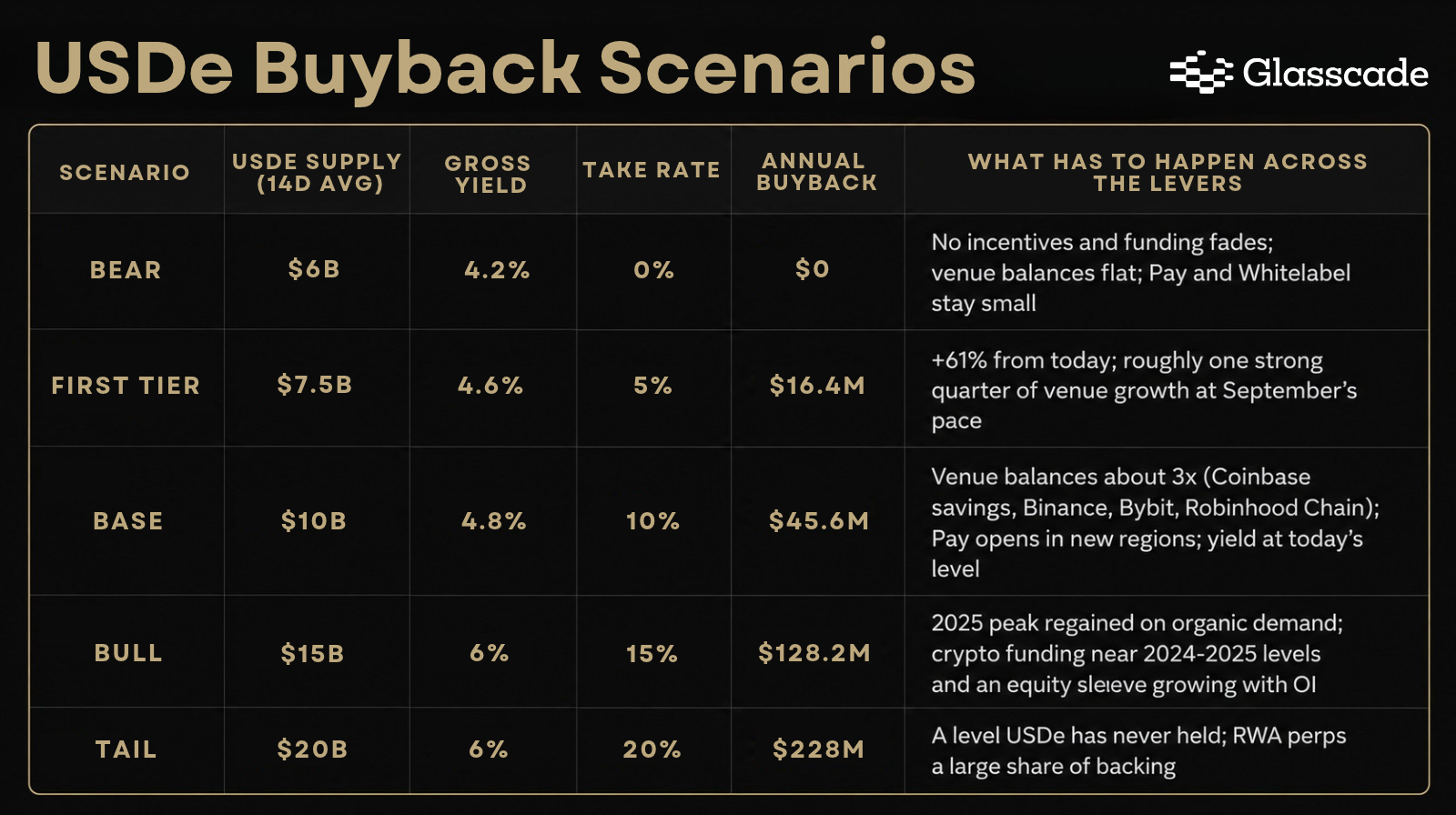
How soon it could start?
That depends on pace. At September's rate of growth (+$760M a month), USDe would reach $7.5B in about four months; at Q3's net pace (+$143M a month), it would take about 21 months. October has gone the other way so far, so the start date is open.
What about the flow that it buys?
The simplest way to read a buyback is in tokens. At a price of ~$0.207, each scenario buys this much ENA a year, set against the 1.61B ENA that team and Foundation unlocks release each year:
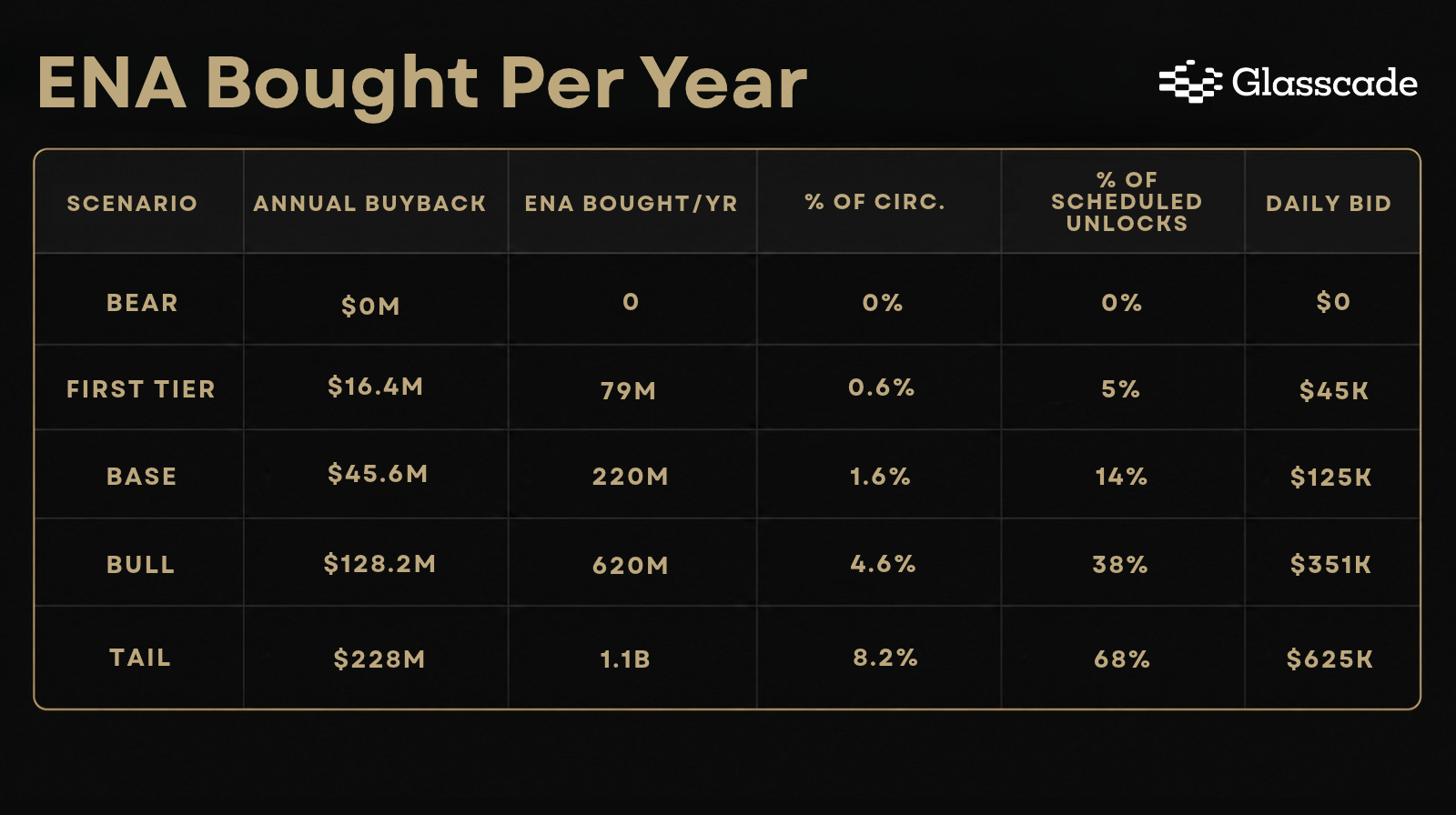
The flow is too small to set the daily price against about $490M of daily volume. Its value is that it is continuous and price-insensitive, and outlasts the unlock schedule it competes with.
What is the valuation?
The flow shows how much ENA the buyback absorbs, not what ENA should trade at. To get from one to the other, the buyback needs a buyback yield - the share of market cap that buyers expect to see repurchased each year.
Since Ethena has not published a target, we anchored our calculations to tokens whose buybacks are funded from revenue and whose businesses overlap with Ethena’s:
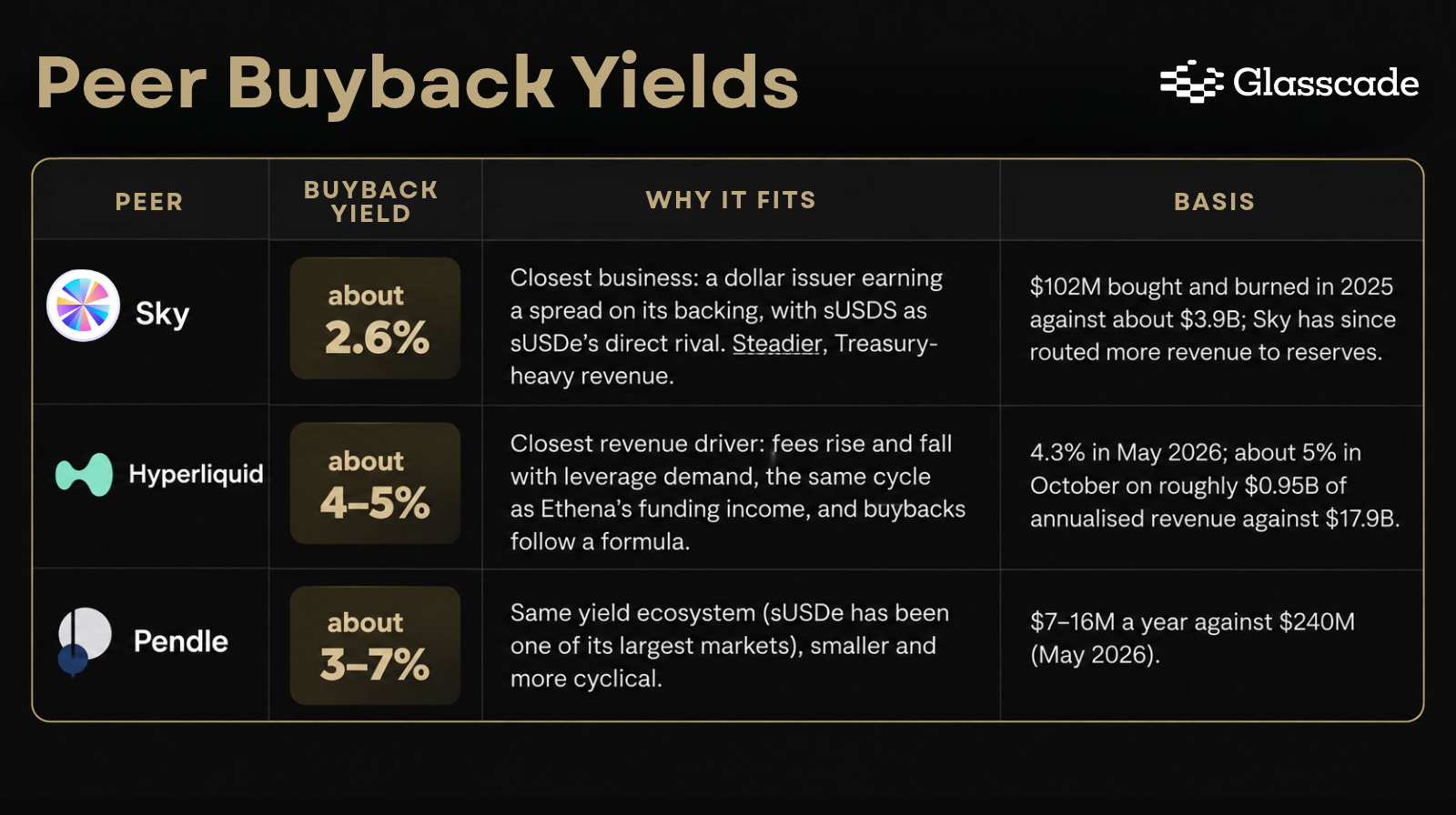
Each peer sets one yield to test the scenarios against:
2.5% is the re-rating case → It is where ENA would trade if USDe became a steady, Treasury-like savings product.
4% is the base → USDe’s revenue still moves with funding cycles, so it prices closer to a derivatives venue than to a T-bill issuer.
6% is the risk case → What the market asks of a small, cyclical, yield-linked token.
Capitalising each scenario’s buyback at those three yields, spread over all 15B ENA (bought ENA is not burned and unlocks continue), gives the value per token the core book supports:
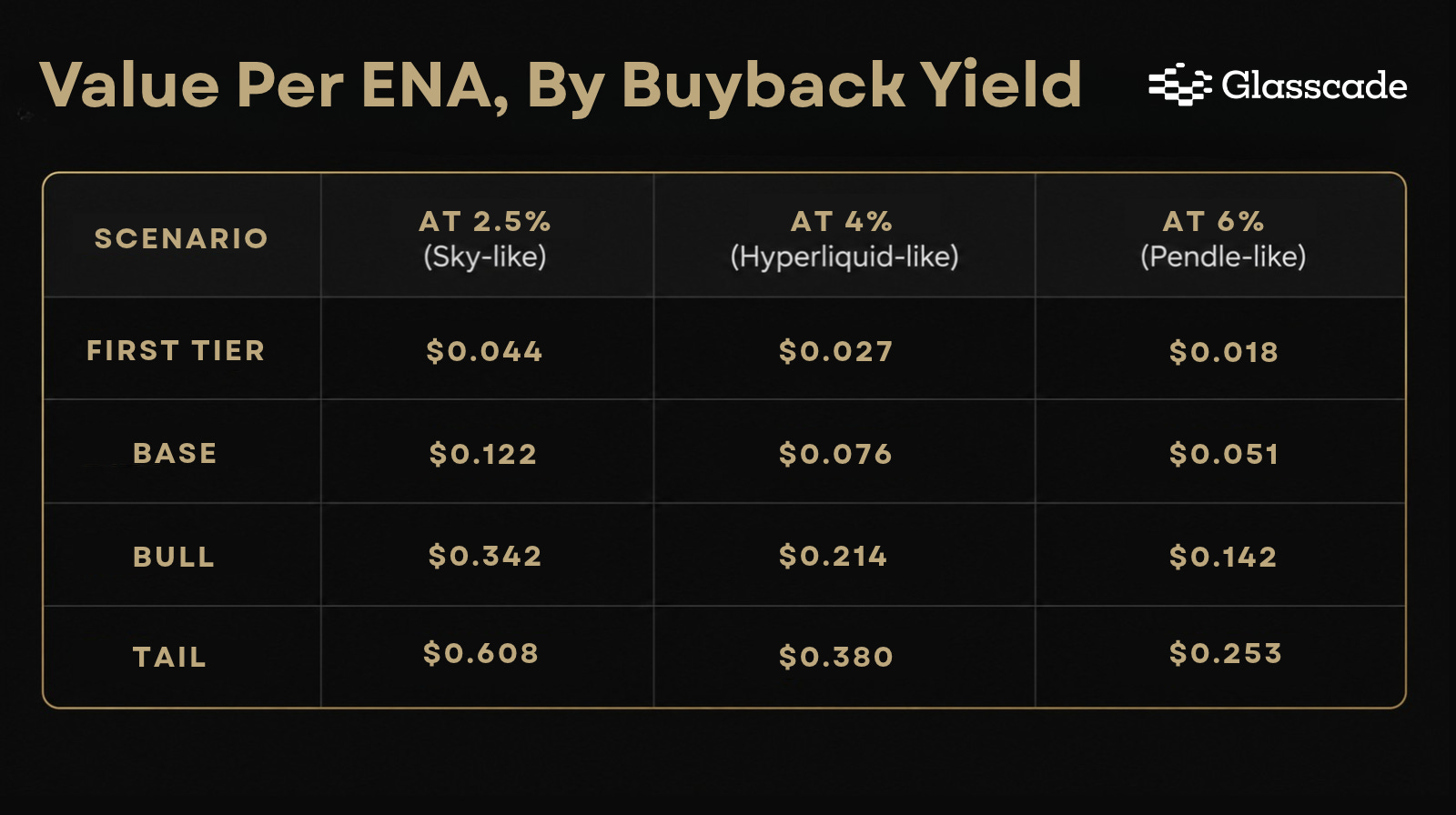
At today’s $2.78B market cap, a Sky-to-Hyperliquid yield of 2.5 to 4% implies $69-111M of annual buybacks: a book of roughly $15-16B at today’s yield. The base case justifies under a third of today’s price and the rest rests on growth beyond $10B, the other two pillars, or optionality value.
Risks To The Pillars
The largest risk is that supply never re-crosses $7.5B without incentives.
Organic demand is untested → Supply fell from $5.00B to $4.56B in the first month without incentives, and the 2025 run to $14.7B was partly points-driven.
Supply can leave fast → USDe lost 56% of supply after the October 2025 liquidation cascade. A tier only helps if supply stays above it.
The take slows the trigger → Each tier trims what sUSDe pays, and its cushion over Sky USDS is 1.5 points; a thinner spread draws less new supply.
Procyclical buying → Supply and ENA price tend to rise together, so the programme buys hardest when ENA is dearest.
New risk in the yield mix → Lending and institutional credit carry credit risk the pure basis trade did not.
Revenue already has claimants → In September, 47% of USDe fees went to the Aave program and 27% to partners; cutting them to protect sUSDe would also cut growth.
Supply on the other side → About 134M ENA a month unlocks to early 2028, plus about 1.09B undated ecosystem ENA and StablecoinX’s roughly 3B ENA, whose lock-up was waived on 5 October.
Where This Leaves The ENA Bid
Core USDe is the pillar that can make Ethena a steady, rule-based buyer of its own token, and its contribution hinges on the return of USDe supply.
The path runs in three steps:
$7.5B turns it on → About $16M a year: proof the mechanism works, not yet a meaningful bid.
$10B makes it matter → About $46M a year, ~1.6% of circulating ENA and 14% of scheduled unlocks.
$15B is what the price already implies → About $103-128M a year, the level at which ENA’s current market cap looks like a buyback-backed valuation.
Certainly, no single lever closes that gap and we will need to see a combination of factors working together to make that happen. It takes venue balances growing several-fold, funding that keeps sUSDe ahead of Treasuries and Sky, an equity sleeve that grows with open interest, and Ethena Pay and Whitelabel stablecoin balances that stay when yields dip.
The bid also strengthens with time. Team and Foundation unlocks end in early 2028, and the buyback plans have no end date, so a base-case programme that offsets 14% of unlocks today becomes a net buyer once they stop.
This is how Ethena has built it → the ladder is designed to support growth back to about $15B, on the way to a stated goal of $100B+ of USDe.
Each tier that supply clears turns that growth into a larger, rule-based bid for ENA, with no further vote needed. For ENA holders, the mechanism is already in place; what remains is for USDe to climb through the tiers.
The information contained in this report and by Glasscade and related affiliates is for general informational purposes only and is not intended to provide legal, financial, or investment advice. The report should not be construed as an offer or solicitation to buy or sell any security, token, or financial instrument and does not represent any recommendation or endorsement of any investment or financial product or service. Glasscade and related affiliates are not registered as a securities broker-dealer or an investment advisor in any jurisdiction or country.
Subscribe to Glasscade to receive valuable insights on stablecoin cards, neobanks, and onchain FX.