

Etherfi Cash crossed $1B in card spend without owning the dollars its users spend or the rails that fund them. In October, it struck three deals in under three weeks to change that. Here is what each one does, and what would have to show up in the data for it to matter.
Most crypto card programs are distribution businesses sitting on someone else’s balance sheet.
The card is theirs, but the dollar a user spends belongs to Circle or Tether, and the money that funds it usually arrives through a ramp the program doesn’t control. That was fine while the category was still proving people would spend stablecoins at all. It matters a lot more once a program has scale.
Etherfi Cash has scale. It crossed $1B in cumulative card spend, and its growth has come from the most durable source a card can have: people using it more often.
In October, Etherfi made three moves aimed at the parts of the stack it didn’t own. It bought a route to Zeal’s card users, brought MoonPay‘s funding rails inside its app, and announced its own dollar on Ethena Whitelabel.
We view these as a bet that Etherfi Cash’s frequency-driven growth can be turned into balance-sheet economics, not just card spend. None of the three moves is fully live yet, and the thesis depends on whether they ship in time. But the direction is clear, and it separates Etherfi Cash from most of the programs it competes with in our rankings.
From Side Product To Growth Engine
In September we measured how Etherfi Cash had grown
over a three-month window:
Monthly tracked volume rose 40.5%, from $69.6M to $97.8M
Almost all of that came from more active addresses transacting more often
Average ticket size barely moved, closer to a debit-card profile than a charge-card
Etherfi Cash ranked second behind only RedotPay across our 7D, 30D and cumulative windows
The pattern has held since. Etherfi announced that Etherfi Cash spending has passed $1B, with more than 12.6M transactions across 199 countries and 131 currencies.
Our own data tells the same story. Etherfi Cash tracked $128.8M in September, up 17.6% on August.
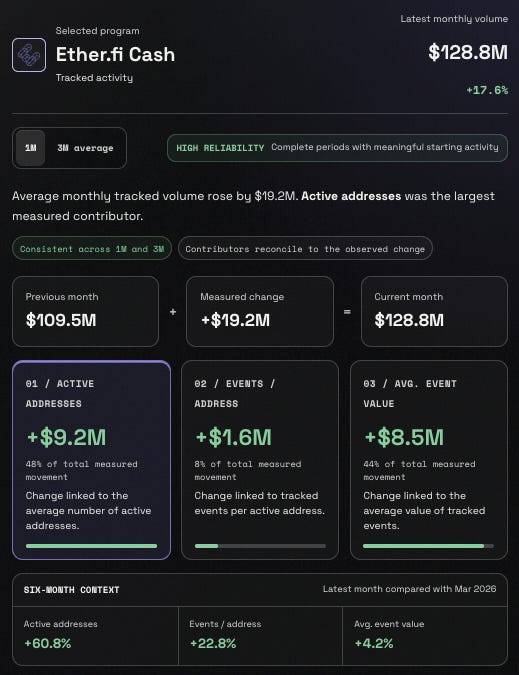
Here is the number that stood out to us. Since March, active addresses on Etherfi Cash are up 60.8% and events per address 22.8%, while average event value has risen just 4.2%. Growth has come from more people using the card more often. September is the first exception: average event value drove 44% of the month's $19.2M increase.

Our end October weekly ranking places Etherfi Cash at #9 on 7D volume change, at +1.3%. That understates its weight. On a base this size, a low single-digit weekly move carries more dollars than a double-digit move at a smaller program. The ranking measures rate, not mass.
Etherfi Cash no longer needs to prove it is more than a side product of a staking protocol. What it needs now is to keep more of the value its card activity creates.
Where Card Programs Leak Value
Most stablecoin card programs run on two pieces they don’t own. Users hold and spend USDC or USDT, so reserve income on those balances accrues to the issuer. Funding, bank transfers and cross-chain deposits route through separate providers, often outside the app and often behind a second identity check.
Each hop adds friction for the user and moves economics out of the program.
Etherfi Cash scaled inside this structure, not around it. Each of October’s announcements targets one layer of it.
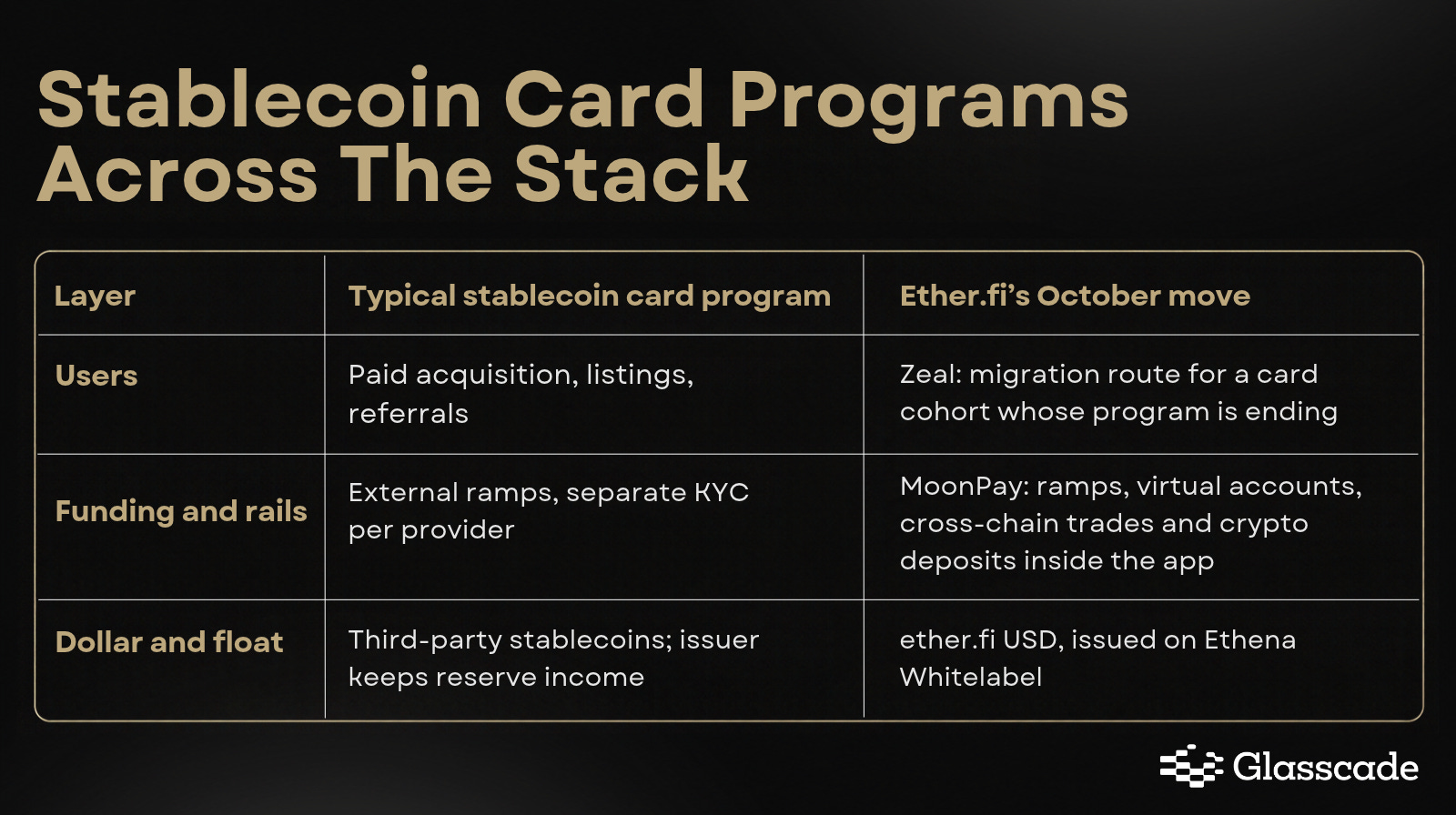
The status column is where the story sits. The layer that is already live brings in users. The two that change unit economics are still in the works, which plays a large part in the thesis. Further official announcements regarding the status of these moves will grant us a clearer picture.
Acquiring A Cohort
In late October, Etherfi announced it had acquired selected assets from Zeal, with terms undisclosed. The deal excludes user accounts, keys and funds. What Etherfi bought is a route to Zeal’s users, which means they grow the spending pie on Etherfi Cash.
That route comes with a deadline, and the mechanics decide how much of it converts:
Zeal is a self-custodial wallet whose Visa card runs on Gnosis Pay
Gnosis Pay’s migration guide ends Zeal card services on 20 December
Migration starts inside the Zeal app, is opt-in, and moves nothing automatically
Users choose which balances to bring, open a new Etherfi account and pass Etherfi’s own verification before receiving a card
Other Gnosis Pay routes remain open, so Etherfi is one option on the exit path, not the only one
Most card programs grow through paid acquisition or listings. Zeal hands Etherfi a cohort that already holds and spends through a self-custodial card, which is the closest match to the Etherfi Cash user we described in September. Because self-custody carries over, the most common objection a Zeal user would have to switching simply does not apply.
The migration should also be measurable. Zeal’s spend has run through Gnosis Pay, so the next eight weeks give us a natural test: Zeal-attributable volume on Gnosis Pay winding down into 20 December, and whether a matching increment shows up on Etherfi Cash. Gnosis Pay serves several front-ends, so isolating Zeal will need address-level attribution, and we will flag anything we cannot separate cleanly.
Owning the Top-Up
In early October, MoonPay became Etherfi’s official payments infrastructure partner.
Over the coming months, four MoonPay products will sit inside the app:
Headless Ramps: fiat on- and off-ramps rendered in Etherfi’s own interface
Trade: cross-chain conversions
Enterprise Virtual Accounts: account and routing details on ACH, Fedwire, SWIFT, Faster Payments, SEPA and Open Banking
Crypto Deposits: funding from external wallets and exchanges
Users verify identity once, keys stay with the user, and MoonPay handles compliance where money crosses between banks and crypto.
Why does a card program care this much about funding?
Because of what we found in September. A user making many ~$80 purchases is constrained less by the card than by keeping the balance topped up. Every top-up that forces a trip to an exchange or a second ramp is a moment where spending can drift to another card. A virtual account changes the role of the balance entirely. A salary or transfer can land in Etherfi directly instead of being moved there.
Etherfi co-founder Rok Kopp set the benchmark as “whatever banking app a user opens every morning.“ That is a primary-account ambition, not a crypto-card one. If it works, we expect it to show up first in transactions per active address, and only later in ticket size.
The Float Behind the Card
On top of the Moonpay partnership, Etherfi announced Etherfi USD, a branded dollar built on Ethena Whitelabel.
Ethena runs reserves, minting, redemptions and compliance end to end. Etherfi supplies the brand, the distribution and the product surfaces the dollar lives in, including Etherfi Cash.
The target is the more than $300M in stablecoin deposits already sitting across Etherfi, which the team wants native to every product it ships.
We covered the Whitelabel model in our earlier Ethena piece. Etherfi joins Jupiter (JupUSD), MegaETH (USDm) and Sui (suiUSDe) on the platform.
What it has not yet disclosed:
Backing: Whitelabel issuers can use USDe, USDtb or other stablecoins
Ticker, chains and launch date
Whether holders earn yield
The revenue split with Ethena
The economics are easy to describe and yet hard to size. Every percentage point of net reserve yield on $300M is roughly $3M a year before Ethena’s share, and the real figure depends on backing mix, revenue split and how much of the $300M actually converts.
The card is what sets Etherfi Cash apart from most issuers here. People who spend often keep money in the account to do it, so a frequency-driven card accumulates float as a matter of course. Until now, Etherfi Cash has made its money at the point of purchase. A native dollar lets it also earn while that money sits waiting to be spent.
What Could Break The Thesis
Three structural risks stand out to us, plus one tied to a specific partner.
Timing. The only live layer is the one that adds users. If the MoonPay rollout or the stablecoin launch slips well past 20 December, Zeal users arrive into the same structure Etherfi Cash had in September: more spenders, same leakage.
Conversion. Zeal migration is opt-in, competing Gnosis Pay routes are open, and no uptake figures have been shared.
Dependency. Etherfi owns the interface, the brand and the user relationship. The regulated plumbing, from fiat rails to reserve management, sits with MoonPay and Ethena. That is a better position than relying on Circle, Tether and assorted ramps, with deeper integration and a share of the float, but it is still a dependency.
The partner risk deserves its own note.
Ethena Pay competes with Etherfi Cash for the same spender. Ethena still earns on issuance if Etherfi Cash keeps winning, so incentives line up for now. We would watch whether that holds if Ethena Pay starts taking share in our rankings.
What We Will Be Watching
Etherfi Cash became a top-two program without owning its users’ dollars or the rails that fund them. That is unusual, and it is why Etherfi Cash is still easy to read as a card attached to a staking protocol rather than a consumer finance product with economics of its own.
The October moves go straight at the three conditions frequency-driven growth depends on, a balance that is funded, available and worth keeping in the app:
Zeal brings people who already transact this way
MoonPay shortens the path from a bank account to a spendable balance
Etherfi USD makes that balance something Etherfi earns on while it waits to be spent
They also change what Etherfi Cash competes on. Most programs in our rankings compete on rewards rates and network reach, which a rival can match quickly. It is positioning to compete on where a user’s dollars live. That is much harder to copy, because it needs a funding partner, an issuance partner and a user base large enough to make both worth signing.
None of this is in the data yet. If each layer works, it should leave a different trace:
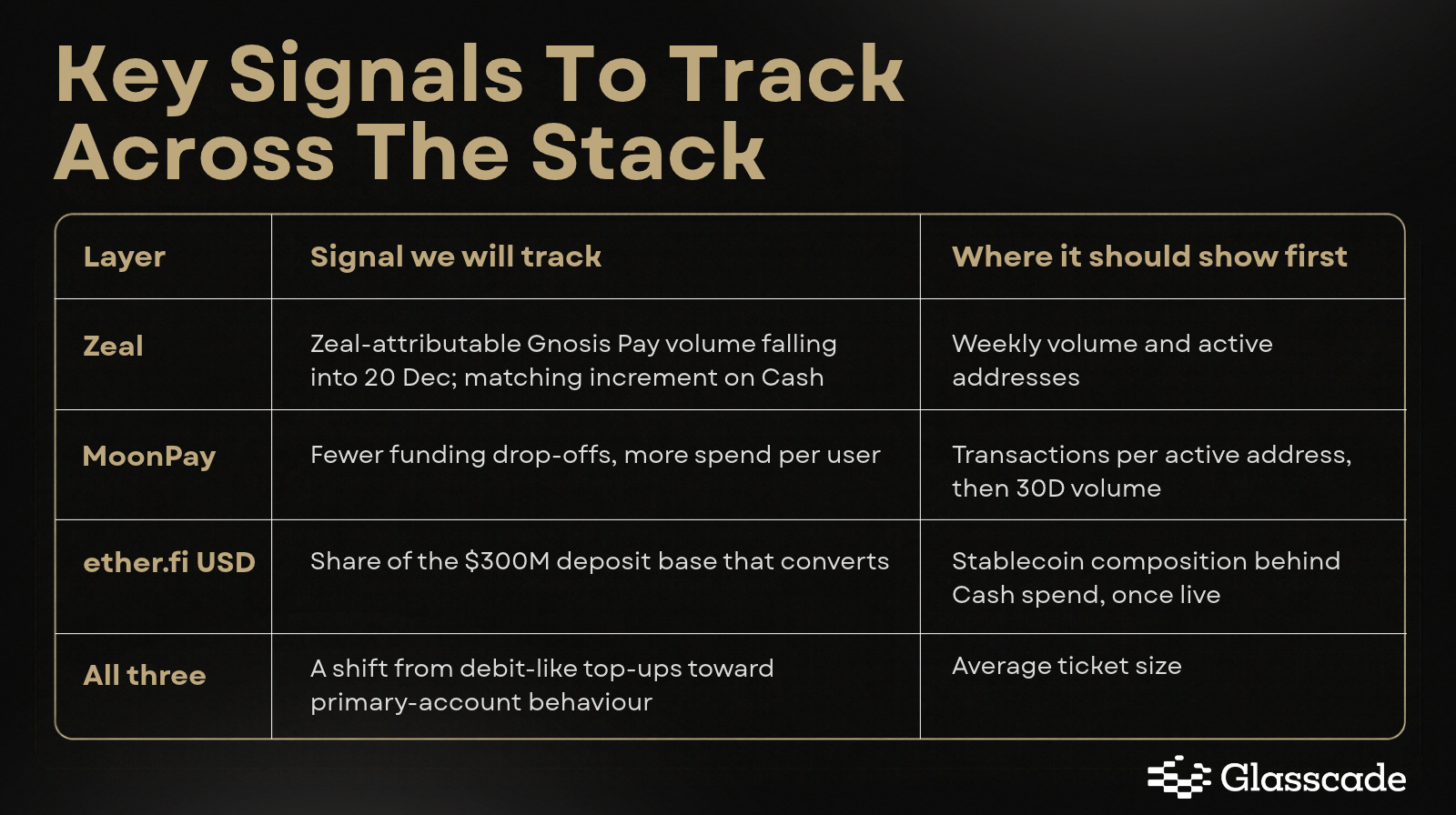
If Zeal migration is meaningful and frequency keeps rising once in-app funding is live, the September pattern compounds. The last row is the one we care about most. Ticket size barely moved for most of Etherfi Cash's growth run, and September is the first sign it may be starting to. If that holds, Etherfi Cash is becoming a primary account, and we will start measuring it as one.
Read our EtherFi Cash Growth Engine research piece
Follow us at glasscade_xyz
The information contained in this report and by Glasscade and related affiliates is for general informational purposes only and is not intended to provide legal, financial, or investment advice. The report should not be construed as an offer or solicitation to buy or sell any security, token, or financial instrument and does not represent any recommendation or endorsement of any investment or financial product or service. Glasscade and related affiliates are not registered as a securities broker-dealer or an investment advisor in any jurisdiction or country.
Subscribe to Glasscade to receive valuable insights on stablecoin cards, neobanks, and onchain FX.