

In this article, you will see why Ethena Whitelabel matters to ENA more through the USDe backing in a partner’s reserves than through the fee Ethena charges. We size it in bear, base and bull cases, show how it builds up over time, and flag what could make it run in reverse.
Key Takeaways
Small today: about $74M of branded supply, roughly 1.5% of USDe. It sends $0 to ENA until USDe passes $7.5B and the fee switch turns on.
Two channels to ENA: Ethena’s cut of partner reserve yield (5-15%, with 10% as our base), and USDe-backed partner supply pushing USDe into higher buyback tiers.
The tier push matters more than the fee: below $20B, each $1B
of USDe in partner reserves is worth about 1.5-2 times more to ENA through the tiers than through the cut.
Scenarios: $0 in the bear case, about $16M a year ($0.22 per ENA) in the bull case, close to Ethena Pay’s base case.
A slow build: on a realistic partner ramp, the base case reaches about $15M a year by 2029.
It cuts both ways: the same channel runs in reverse. One large partner redeeming USDe-backed supply can drop USDe a tier.
Understanding The Money Flow From A Partner’s Stablecoin to ENA
Ethena does not publish what it keeps from a white-label deal, so we build the model from public deal terms.
Here is an example to set some context.
Ethena sits akin to where Arbitrum relates to Robinhood Chain: it licenses the stack and takes a cut of what the partner earns. Arbitrum takes 10% of net revenue from external chains on its stack, while Ethereum is paid a data-posting cost rather than a share. For Ethena, the base layer is the T-bill and basis yield behind the reserves.
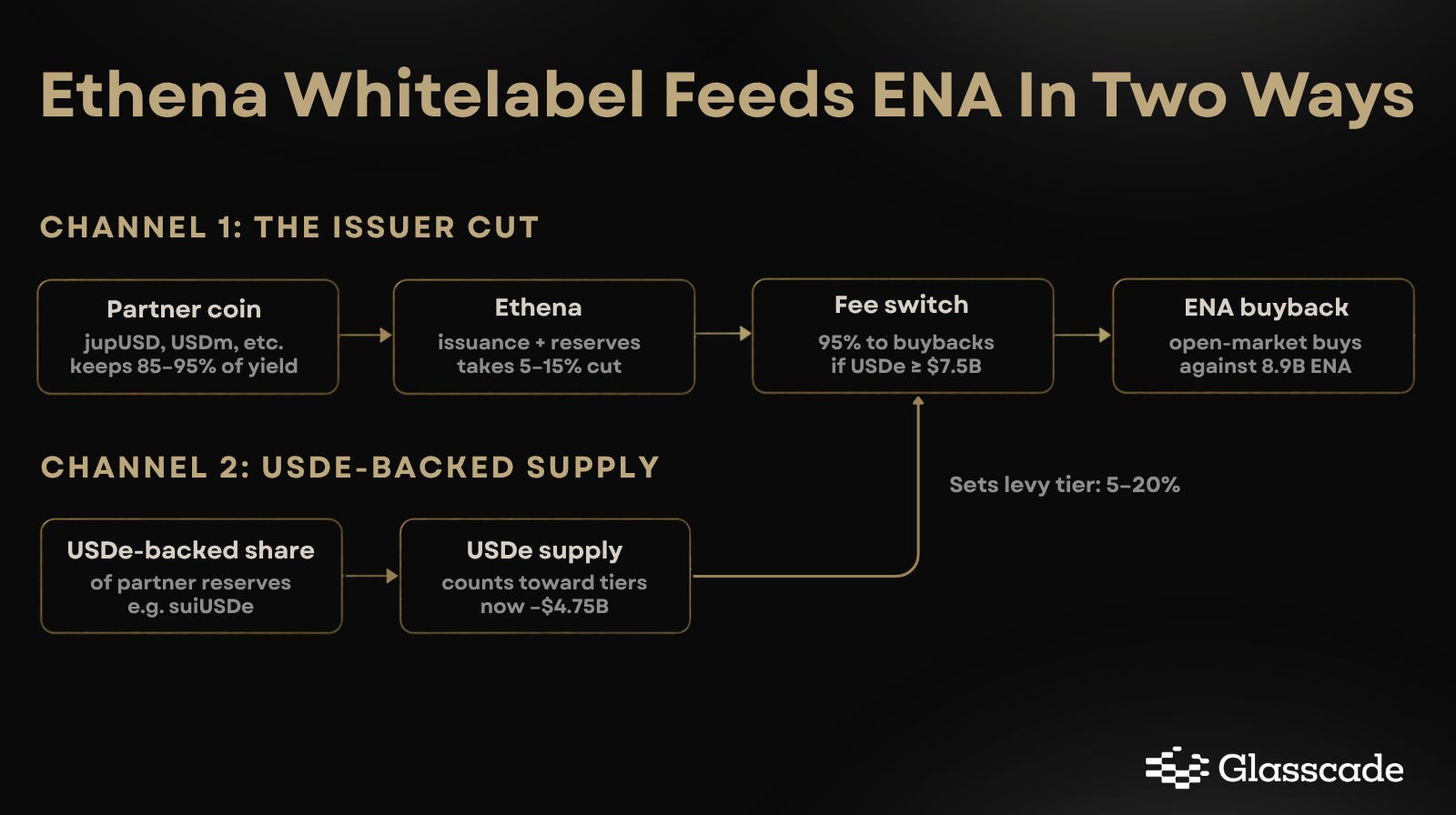
The difference is where the cut ends up. ARB’s share sits in a DAO treasury, while Ethena’s feeds a programmatic ENA buyback once USDe passes $7.5B. A USDe-backed partner coin also adds to USDe supply, which sets how large that buyback is.
Where Does Whitelabel Stand Today?
Four branded deployments are live or announced, plus one liquidity integration. Most of the live supply is backed by USDtb and USDC, not USDe.
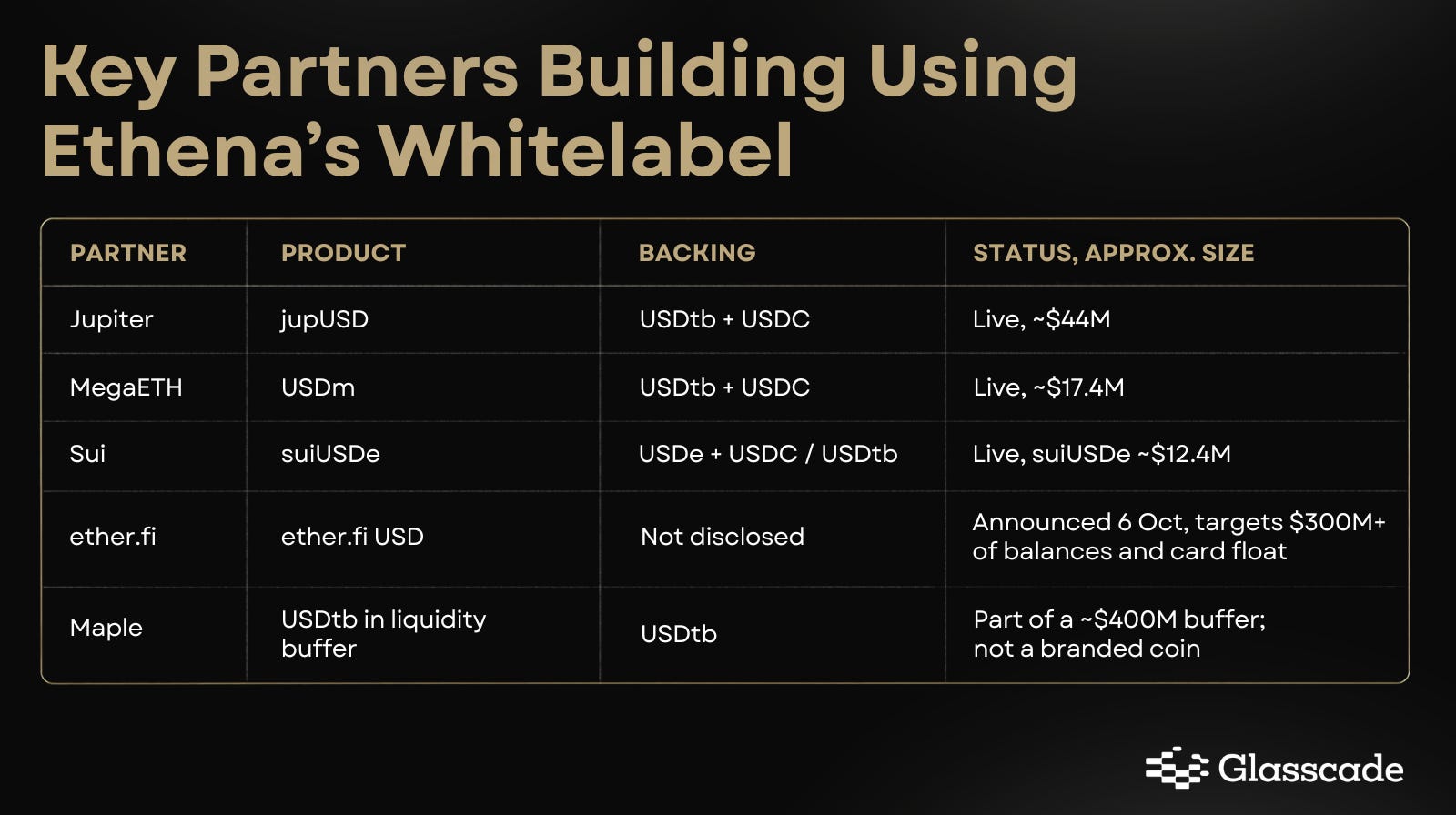
The mix matters because only USDe-backed supply counts toward the USDe figure that turns the fee switch on. Of today’s ~$74M, roughly $12M qualifies
Gross reserve yield today: about $2–3M a year, since a large share of the reserves sits in USDC that earns nothing for the issuer.
Ethena’s share: a few hundred thousand dollars a year at most.
Reaching ENA: nothing, because USDe supply is about $4.75B against a $7.5B switch-on threshold.
EtherFi is the first deal that could change the scale, if its existing balances migrate.
How Much Can Ethena Charge Before Partners Walk?
We set the issuer cut at 5–15% of reserve yield, with 10% as the base case. The range comes from what stack providers already take and what Ethena itself has bid.
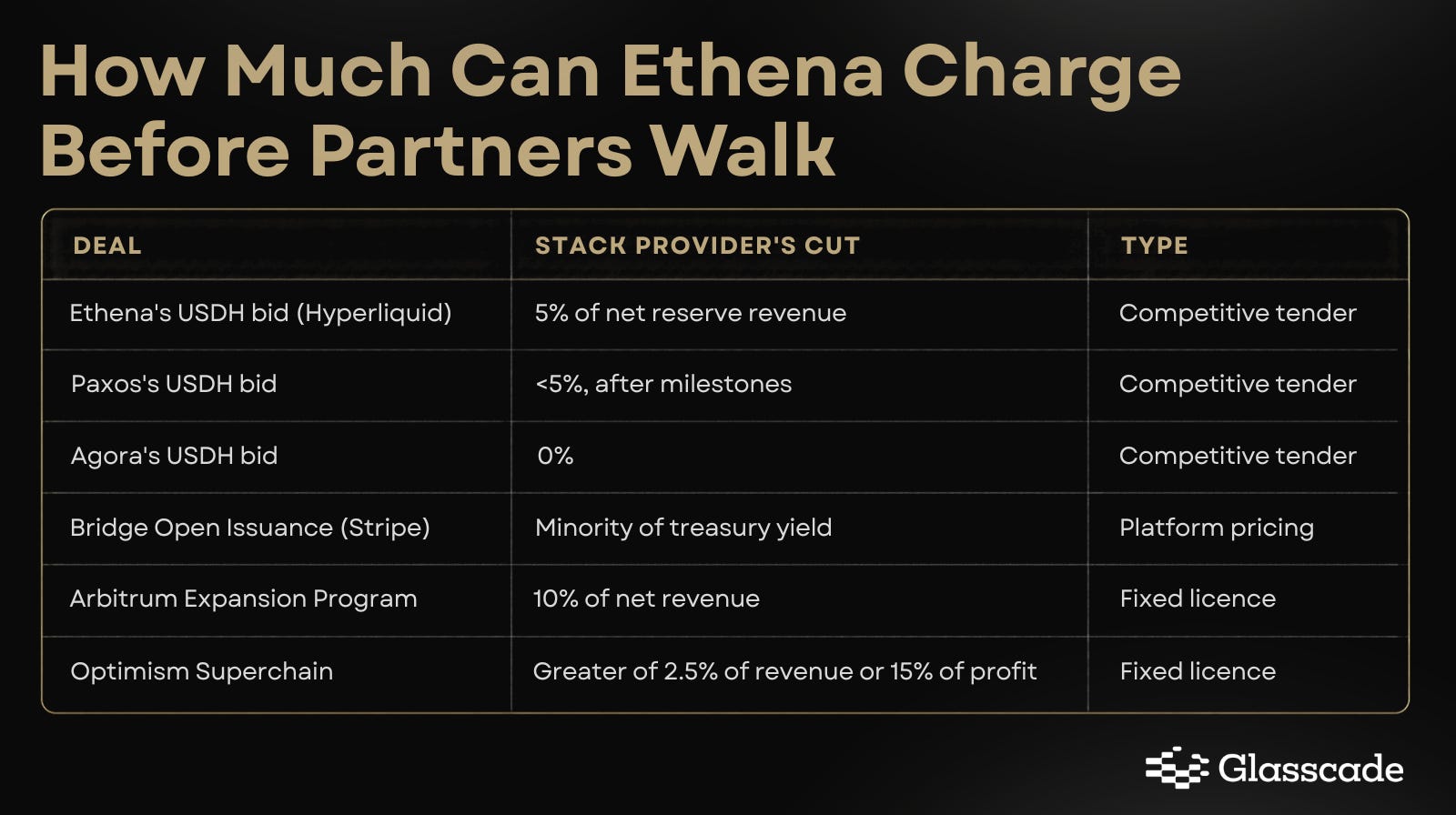
The tender bids set a floor, and the licences show what partners accept when the stack is hard to replace.
5% floor: T-bill-only deals where Ethena competes with Paxos, Agora and Bridge on a commodity product.
10% base: bilateral deals where Ethena brings integrations and liquidity, as Jupiter and MegaETH did. This is the Arbitrum rate, which partners already treat as normal.
15% ceiling: USDe-heavy backing. Basis yield is the one input no rival issuer can offer, so it can carry a premium.
At 10%, a partner still keeps 90% of the yield. That is the pitch at every point in the range.
How Much Supply Does The Fee Alone Need?
Through the direct cut alone, Whitelabel needs tens of billions of supply to move ENA. Our base backing mix is 25% USDe at 6%, 60% USDtb at 3.5% and 15% USDC at zero, a blended 3.6%. At a 10% cut, every $1B of partner supply produces about $3.4M a year of buybacks.
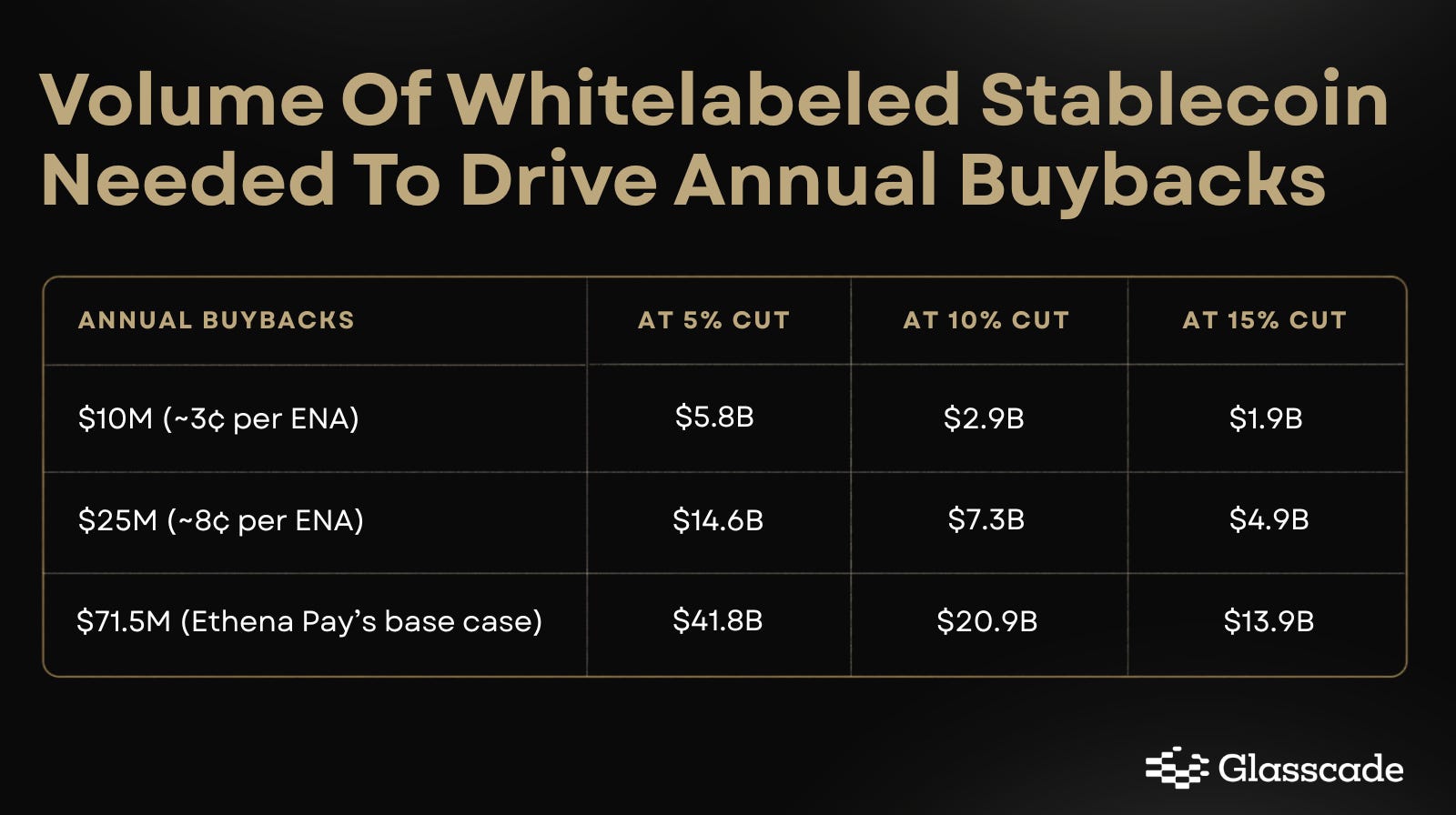
Even the smallest target is 25-80 times today’s supply. If the cut were the only link to ENA, Whitelabel would stay as a benchwarmer in the thesis for years.
How Does Whitelabel Push USDe Across The Buyback Tiers?
A partner coin backed by USDe adds to USDe circulating supply, and that can lift the levy on Ethena’s entire core book. The fee switch takes 5% of gross revenue once USDe passes $7.5B, then 10% at $10B, 15% at $15B and 20% at $20B. Under our reading, each crossing reprices the whole base, not just the dollars above the line.
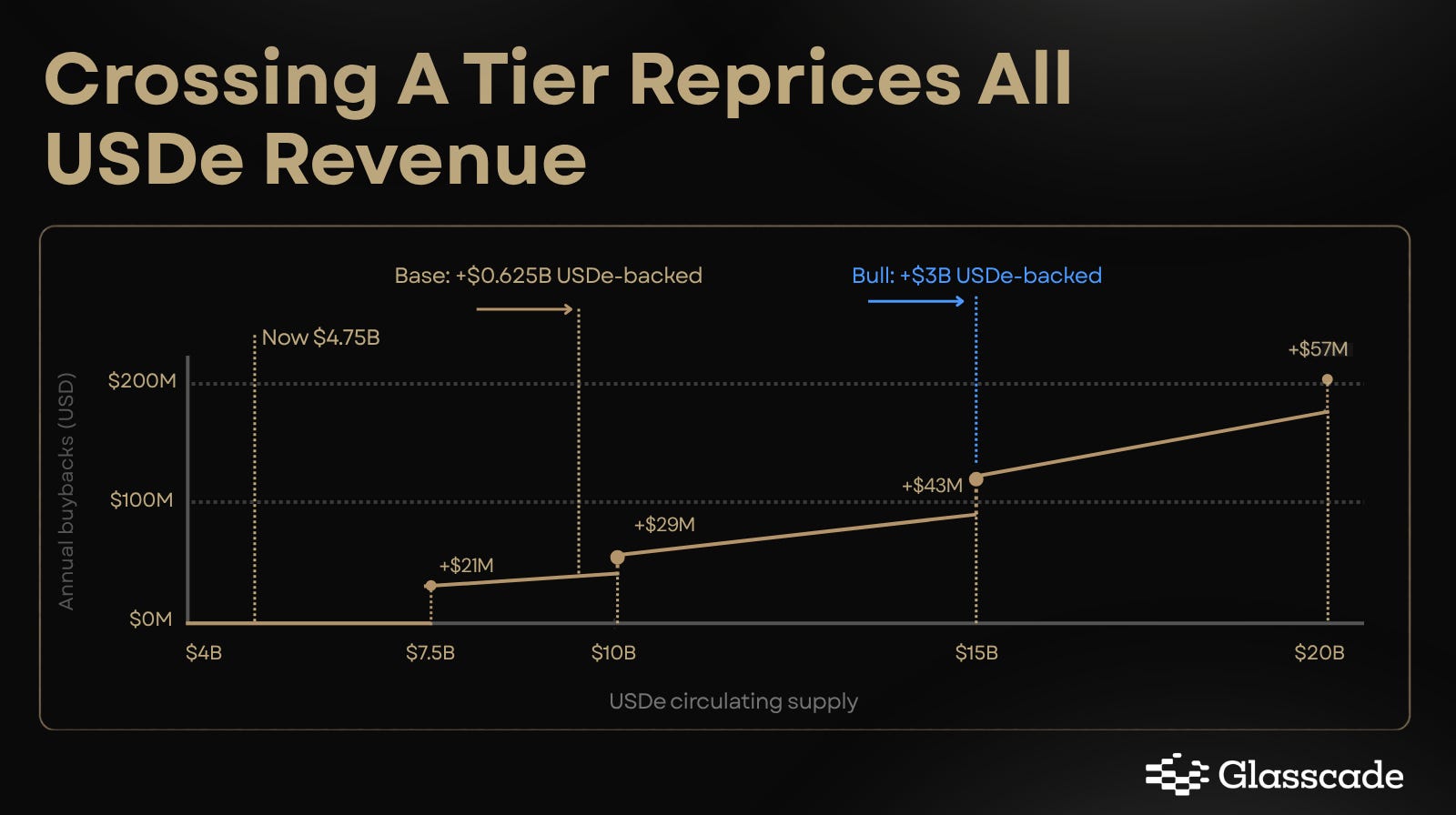
Each arrow starts at a scenario’s core USDe supply and runs as far as Whitelabel’s USDe-backed supply carries it. In the bull case it clears $15B. In the base case it falls short of $10B on its own, so we count it only as a 25% chance of being the deciding supply.
The first rung lines up with the Foundation’s own estimate of about $22.5M a year at $7.5B, before the 5% growth reserve is taken out.
Why it matters: in our base case, $625M of USDe-backed partner supply that tips USDe past $10B adds ~$29M a year. The full $2.5B of partner supply earns ~$8.6M through the cut.
What it implies: backing mix matters more than the fee. Ethena should trade a lower cut for more USDe in a partner’s reserves.
Caught your attention yet? Subscribe to Glasscade to not miss out on these insights.
How Much Could Whitelabel Add To The ENA Bid?
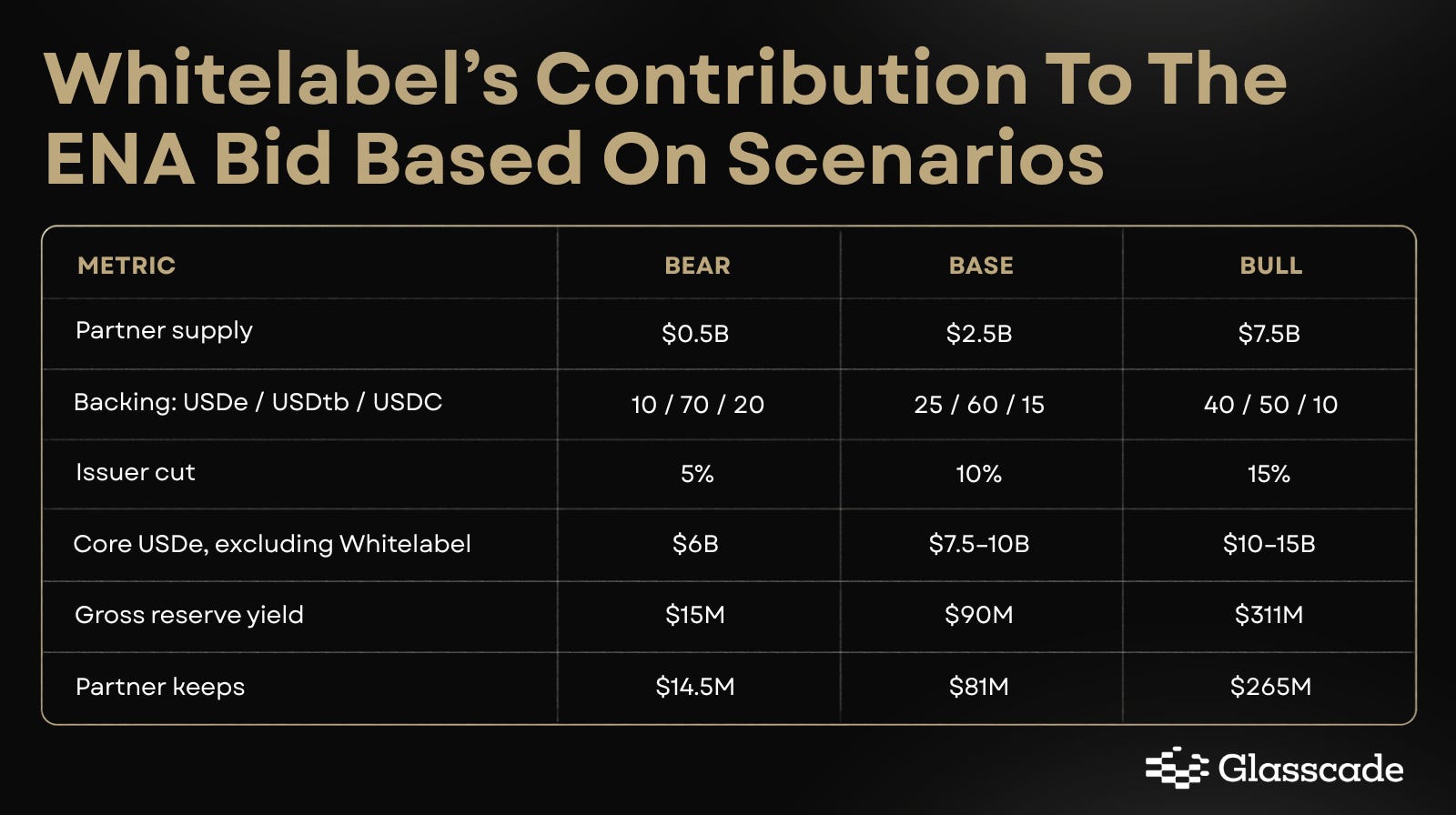
We convert buybacks into value with the yardstick from our Ethena Pay piece: a 3.5% equilibrium buyback yield across 8.9B circulating ENA, so every $10M a year of buybacks is worth about 3 cents per token.
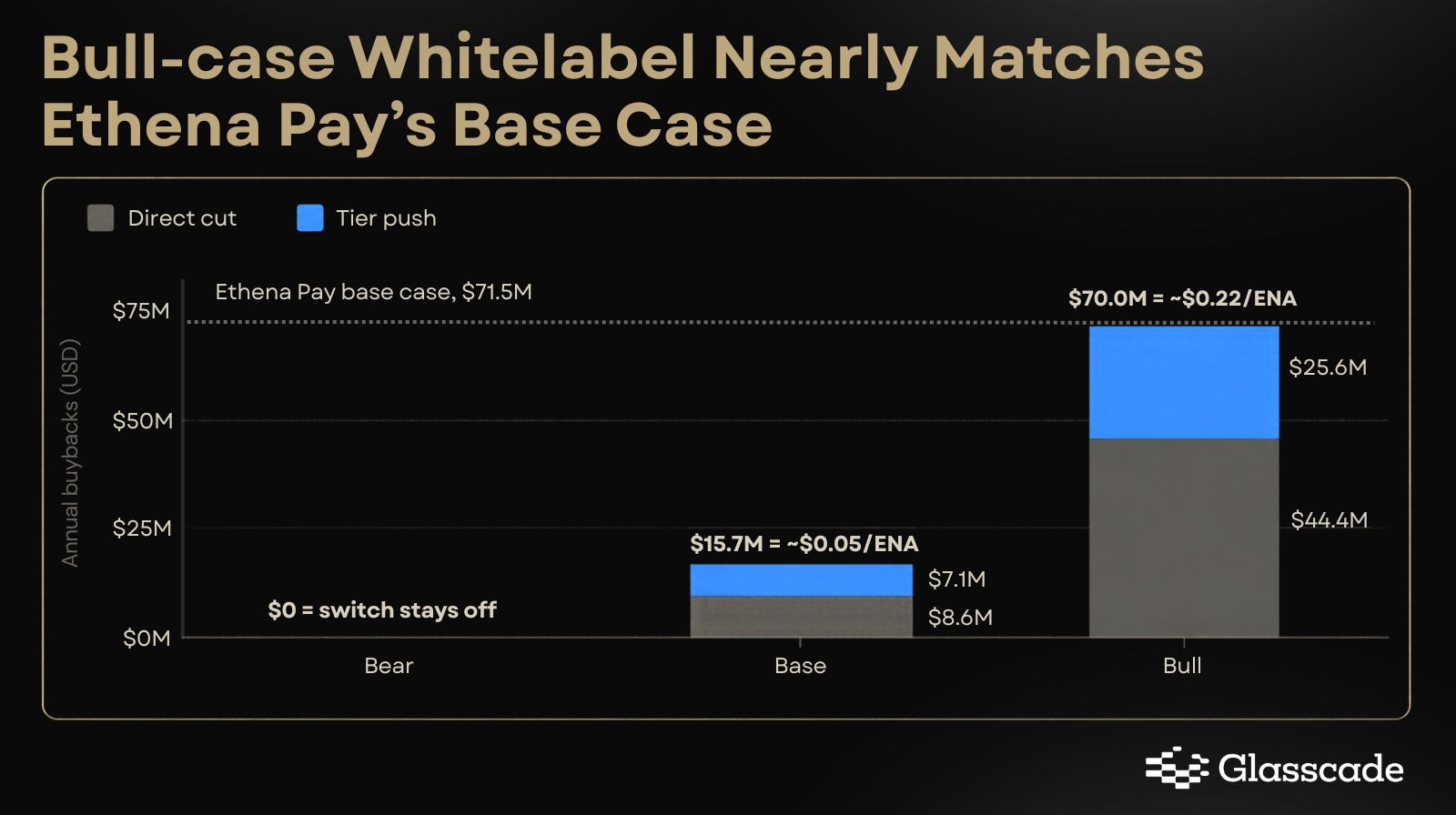
Each case describes a different kind of business:
Bear: Ethena earns about $0.76M, but USDe never reaches $7.5B, so nothing reaches ENA.
Base: a full Etherfi migration plus four large deals of about $0.5B each, such as an exchange or an L1’s native dollar. The tier push contributes almost as much as the cut.
Bull: a Hyperliquid-scale win plus a full Etherfi migration. More than a third of the buybacks come from the tier push.
All three business lines route into the same buyback against the same supply. Stacked with Ethena Pay’s base case ($71.5M), Whitelabel’s base case lifts combined buybacks to about $87M a year, roughly 28 cents per ENA on top of Standard Chartered’s $2.
Our Estimated Whitelabel-Partner Build-Up Rate Over Time
On a realistic ramp, the base case’s $2.5B of partner supply is a 2029 outcome, not a 2027 one.
Partner Supply Ramp
Partners do not launch at full size, so we assume each deal reaches:
25% of its target by the end of the year it is signed
75% by the end of the following year
100% from the third year on
The base-case pipeline runs on that curve:
2026: Etherfi signs, targeting $0.3B
2027: three large deals of about $0.5B each, such as an exchange or an L1’s native dollar
2028: two more of the same size
Core USDe, excluding Whitelabel: $5.5B, $8B, $11B and $14B at the end of 2026 to 2029. This is a modest path, well below Standard Chartered’s $40B for 2028.
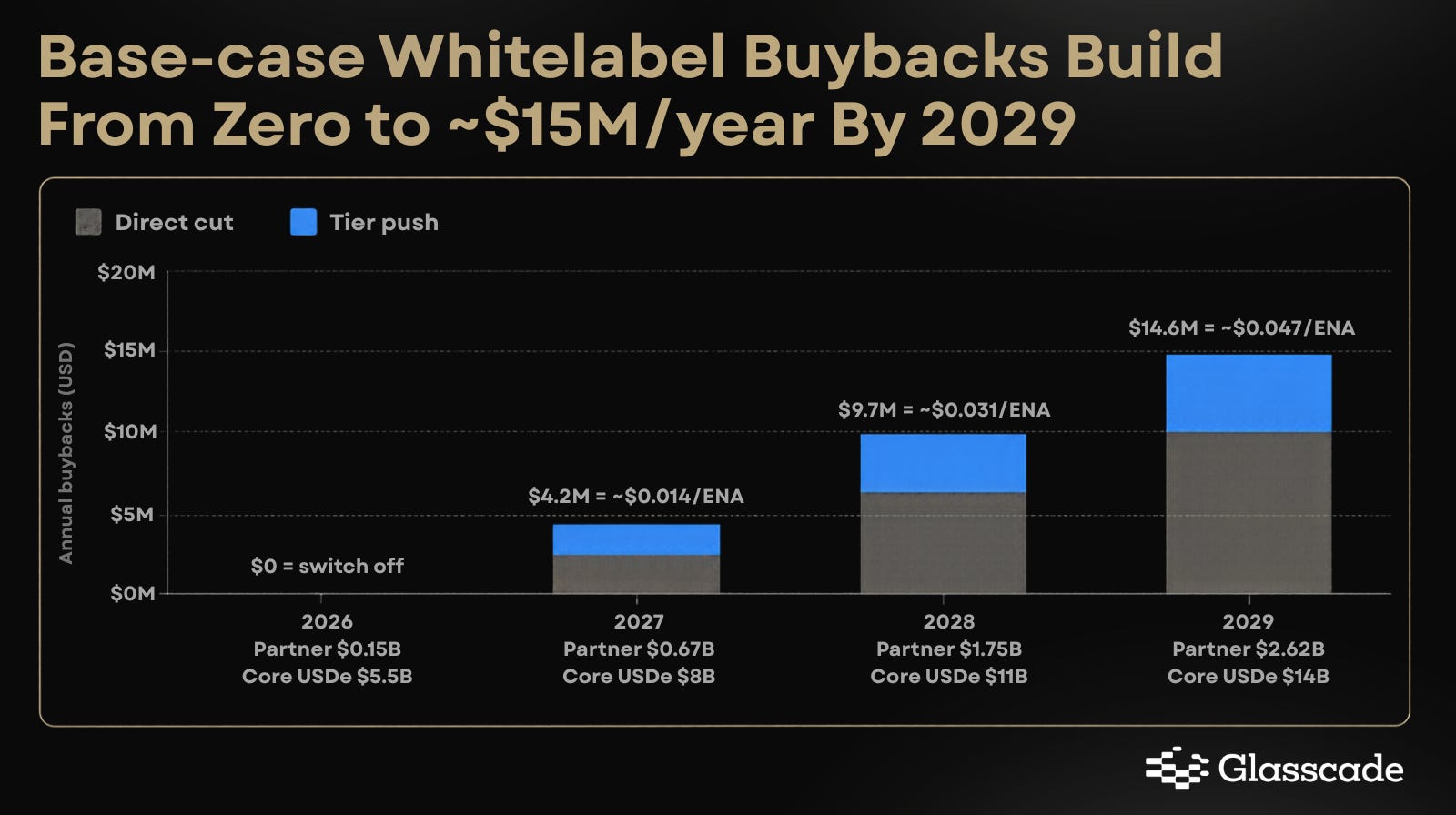
By 2029 the build-up converges on the static base case.
How The Tier Push Changes The Buybacks
The tier push is worth most while USDe climbs the ladder, and nothing once it reaches the top. Ethena’s published ladder ends at 20% at $20B, so there is no rung above that for partner supply to push across.
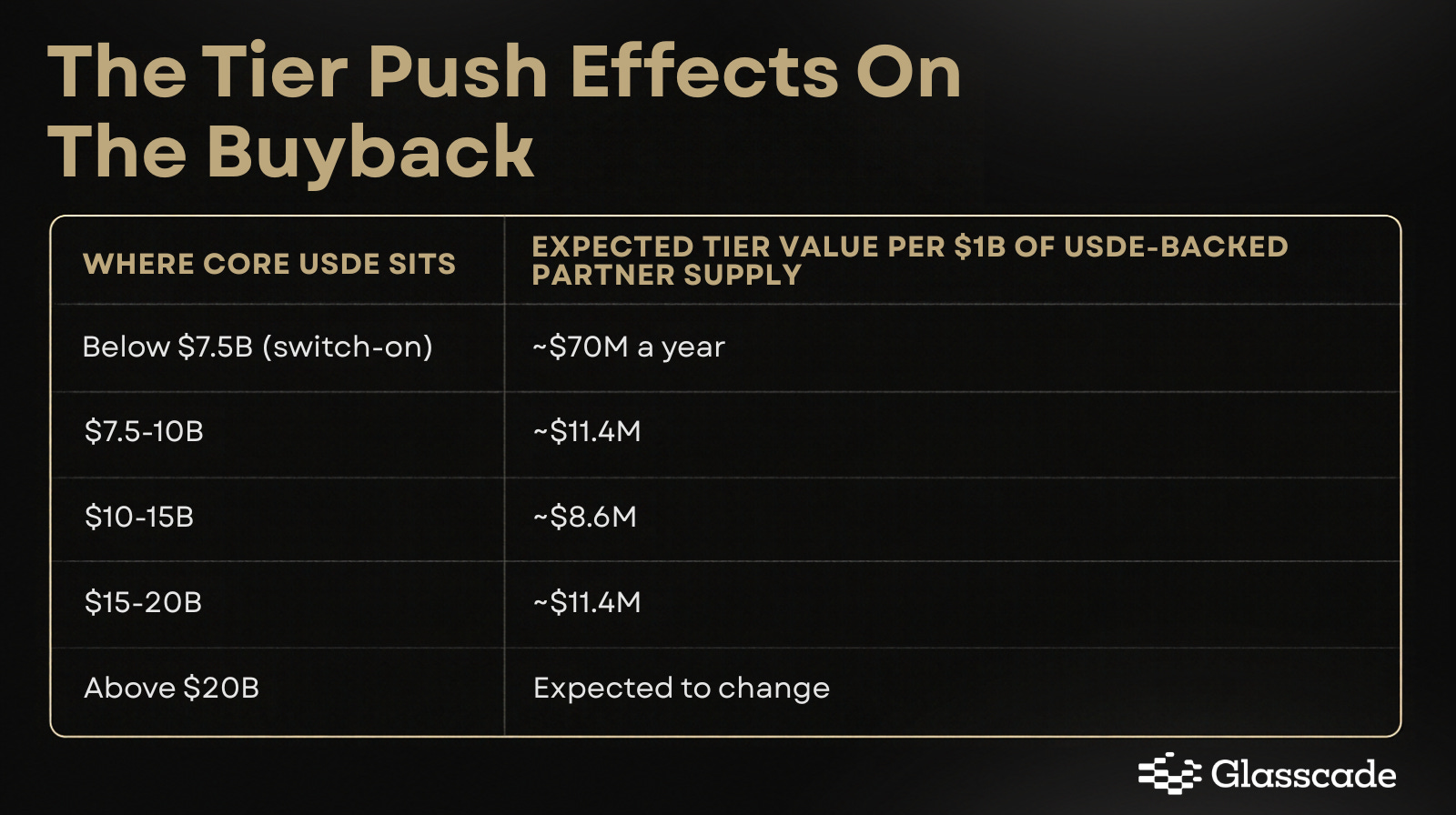
For comparison, the 10% cut on that same $1B of USDe backing earns about $5.7M a year.
Below $20B: USDe in partner reserves does more for ENA through the tier push than through the cut, by roughly 1.5 to 2 times.
Over time: Whitelabel’s role shifts from moving USDe up the ladder to adding revenue on top of it. The faster core USDe grows, the sooner that shift happens.
What Happens When The Tier Push Runs In Reverse?
The channel that lifts buybacks fastest can also remove them fastest.
USDe-backed partner supply is still USDe, and USDe has already shrunk by two-thirds once, from about $15B in October 2025 to under $5B this year.
Dropping a tier costs the whole step: a slip from $10.2B to $9.8B moves the levy from 10% back to 5%, and annual buybacks fall from about $58M to $28M.
The bull case can unwind: if the $3B of USDe-backed partner supply redeems, USDe falls from $15.5B to $12.5B and buybacks fall from about $133M to $71M a year. That is a loss of roughly $61M from one partner’s backing decision.
Partners rotate when funding turns: in a negative-funding market, USDe earns less than T-bills. A partner choosing its own reserve mix would move toward USDtb at the moment USDe supply most needs support.
History says the switch is intermittent: a Blockworks backtest found the trigger would have been active on only 118 of the past 705 days.
The design has two buffers. The trigger uses a 14-day average of USDe supply, so a short dip does not flip a tier. In the same backtest, sUSDe still out-yielded Sky’s sUSDS after the buyback’s cut on 82 of the 93 days it led, so the cut rarely costs sUSDe its yield edge.
For partners, this sets a trade-off Ethena has to price. USDe-heavy backing earns the 15% cut and does the most for ENA, but it also exposes a partner’s reserves to funding risk. A deal that guarantees a USDtb floor in the mix would make the bull case sturdier, at the cost of a smaller tier push.
What Would Change These Numbers?
Four inputs Ethena has not published could move each case by half or more.
Flat or marginal levy: we assume a crossing reprices all USDe revenue. One report describes the switch as incremental. If the levy only applies above each threshold, the tier push almost disappears, and the base case falls to ~$8.6M with the bull case at ~$44M.
Levy on the issuer cut: we treat Ethena’s cut as net revenue, with 95% going to buybacks, as we did for Ethena Pay. If the tiered levy also applies to the cut, direct buybacks fall by 80-95%.
ENA supply: the per-ENA values assume 8.9B circulating. After the 5 October unlock, a higher count lowers them in proportion, by about 11% at 10B.
Partner concentration: Base produced about 71% of Superchain sequencer revenue in 2025 while paying the 2.5% minimum. If Etherfi becomes Whitelabel’s Base, it gains the same leverage to push the cut toward the floor.
USDe yield is also a variable. Our 6% assumption follows the Foundation’s own, and lower funding rates would shrink both channels.
What should ENA holders watch?
Three data points would sharpen this model most:
The USDe share of Etherfi USD’s reserves once it launches
Any disclosed issuer cut on a live deal
Whether the fee-switch levy is flat or marginal across tiers
Until then, Whitelabel’s main contribution to ENA holders is helping USDe reach the thresholds where every business line starts buying back the token.
Get the fuller picture with our thesis on Ethena Pay's contribution:
The information contained in this report and by Glasscade and related affiliates is for general informational purposes only and is not intended to provide legal, financial, or investment advice. The report should not be construed as an offer or solicitation to buy or sell any security, token, or financial instrument and does not represent any recommendation or endorsement of any investment or financial product or service. Glasscade and related affiliates are not registered as a securities broker-dealer or an investment advisor in any jurisdiction or country.
Subscribe to Glasscade to receive valuable insights on stablecoin cards, neobanks, and onchain FX.