

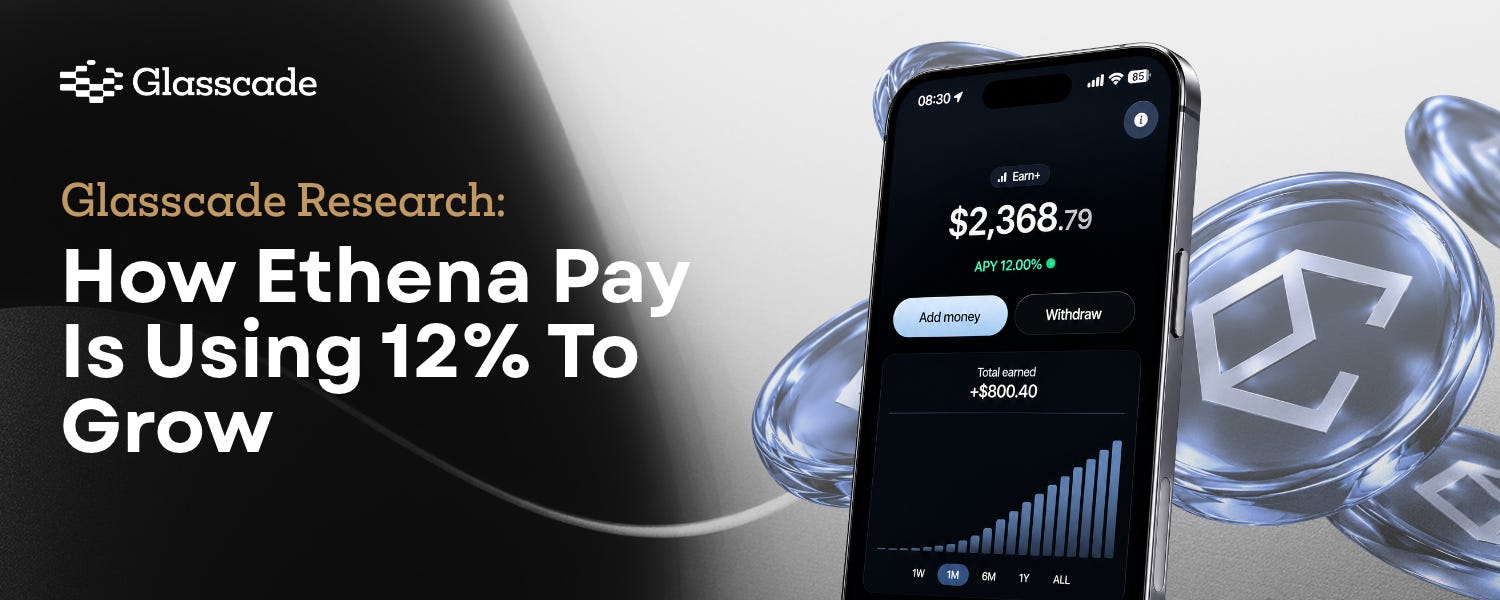
Following our pieces on Ethena Pay, Whitelabel and core USDe supply, we look at Earn+, the 12% vault that Ethena Pay just launched. We cover how the yield works, what it costs, and why we see it as a growth feature that brings in deposits and adds USDe supply on the way to the fee switch.
Double-digit yields on dollars are nothing new in crypto, and neither is the way they end. Subsidised yield has been the fastest route to supply growth for every synthetic dollar this cycle, and the supply it buys has consistently been the first to leave once rewards normalise.
What has changed is where that yield now shows up: one tap away inside a card app, offered to users who may never have opened a lending market.
Ethena Pay launched Earn+, an opt-in vault inside the app offering up to 12% on dollars, more than double what sUSDe has paid for most of this year.
Earn+ works as the growth feature for Ethena Pay rather than a new line of business. It gives users a stronger reason to deposit and keep their dollars in the app, and every dollar that enters the vault is held as USDe, adding to the supply that drives the fee switch.
We view it as a well-priced acquisition tool, funded largely by yield the protocol already earns, whose value to ENA runs through two channels we have already covered, Ethena Pay and core USDe supply. How much it delivers depends on whether the 12% brings in users who stay, and spend.
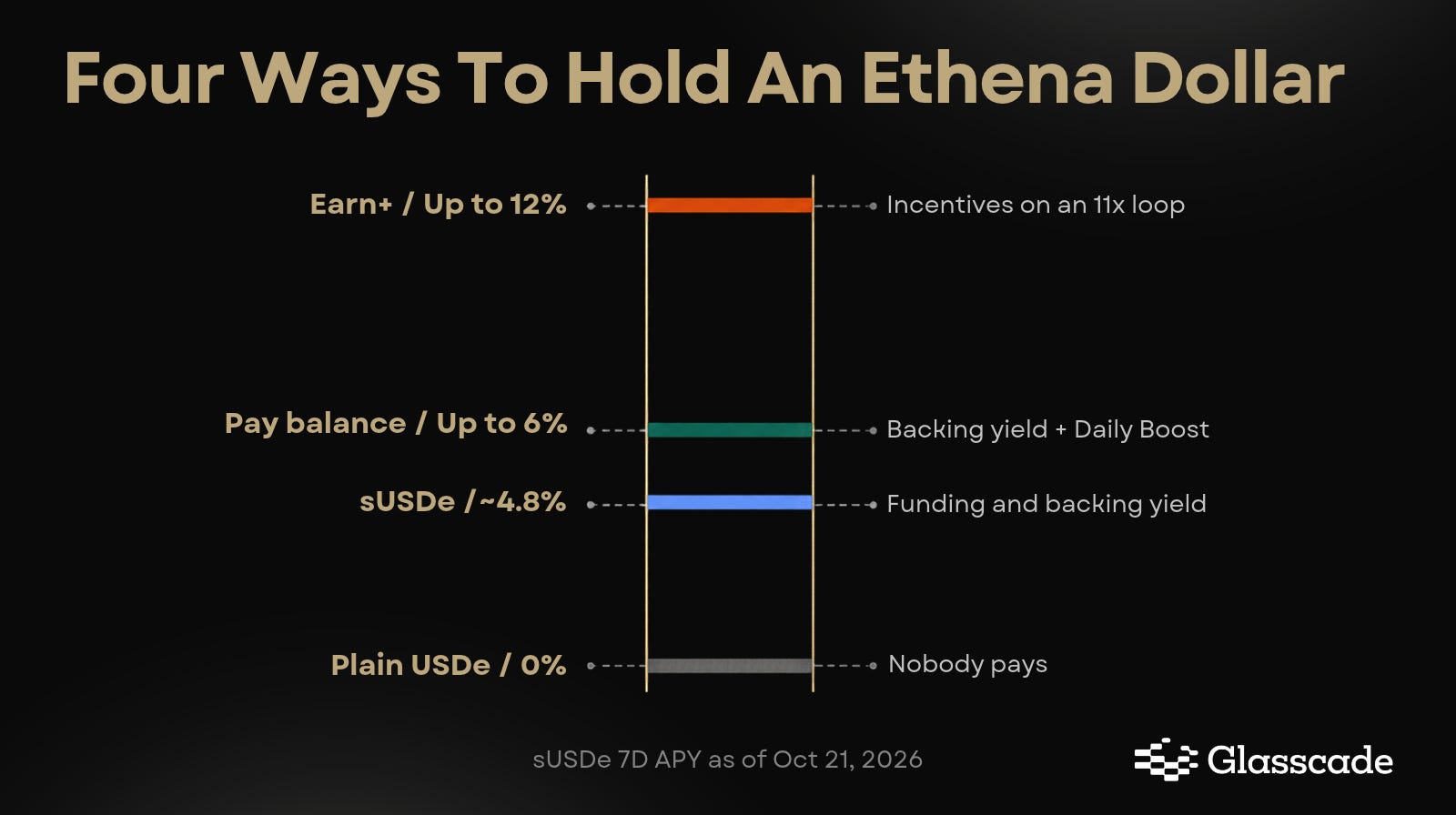
*Correction: Holding USDe at some places also reaps yield
Let us start with looking at how the yield is built.
Anatomy Of A 12% On The Dollar
To start, we need to be clear on the mechanics in play.
Earn+ is not solely run by Ethena.
Instead, the vault is operated by Upshift and curated by Steakhouse, and Ethena Pay is explicit that it provides the interface while neither managing nor guaranteeing the assets.
The strategy itself is a familiar one: it supplies USDe as collateral on Aave v4 Avalanche, borrows USDT, buys more USDe with it and repeats the process until leverage reaches roughly 11x. Deposits are capped at $4.5M across all users, with per-user limits of $20K, $50K and $200K for Standard, Pro and VIP tiers, and withdrawals carry no lock-up beyond a 24 hour processing target.
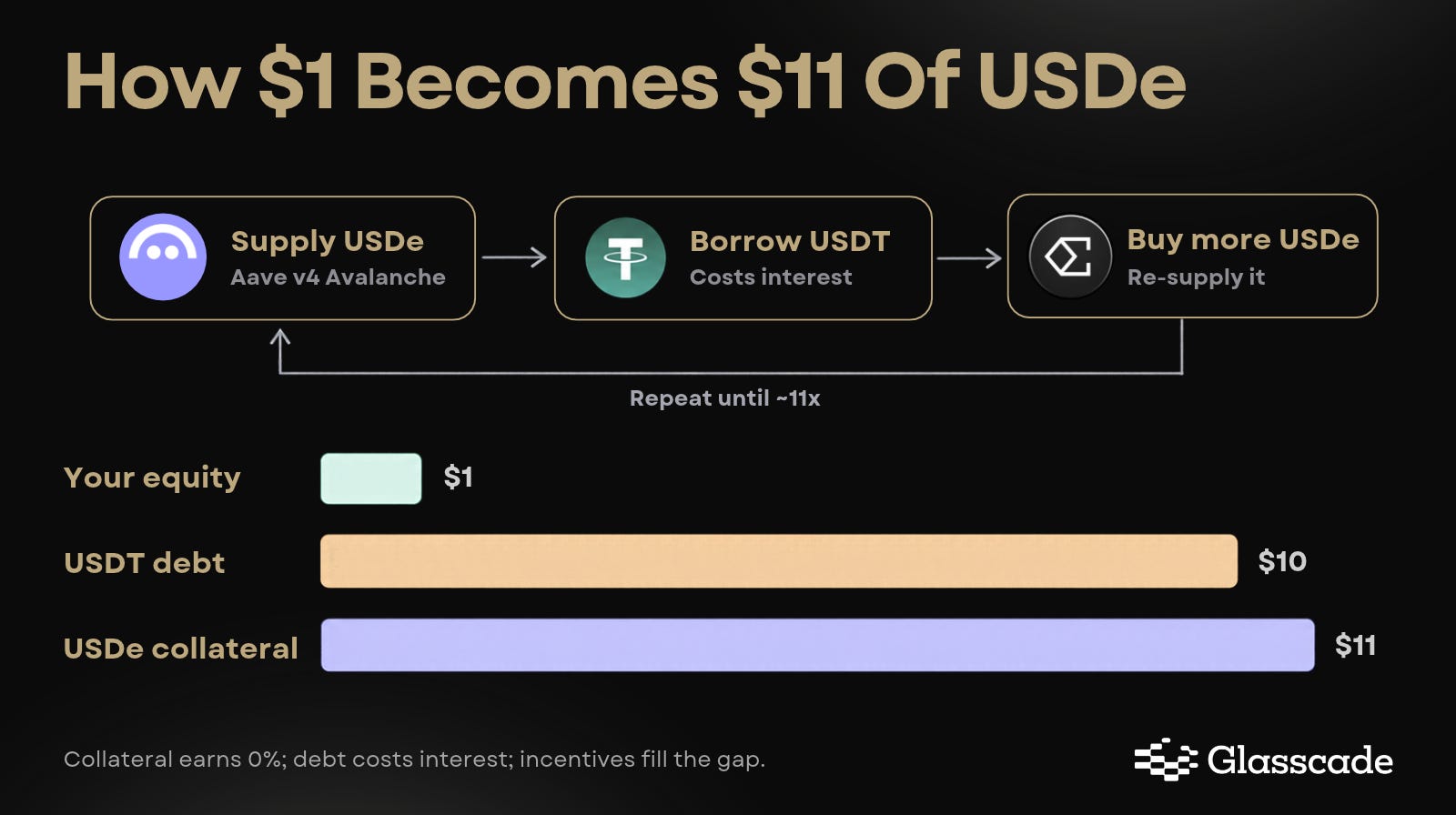
The striking part is that the loop does not pay for itself. A leveraged position only makes money when the collateral earns more than the debt costs, yet plain USDe earns nothing from Ethena, since only sUSDe receives the protocol’s yield. With USDT costing money to borrow on Aave, the loop on its own loses money at every leverage level, and loses more the higher it goes.
Now, its time to understand where the 12% comes from.
Following The Subsidy
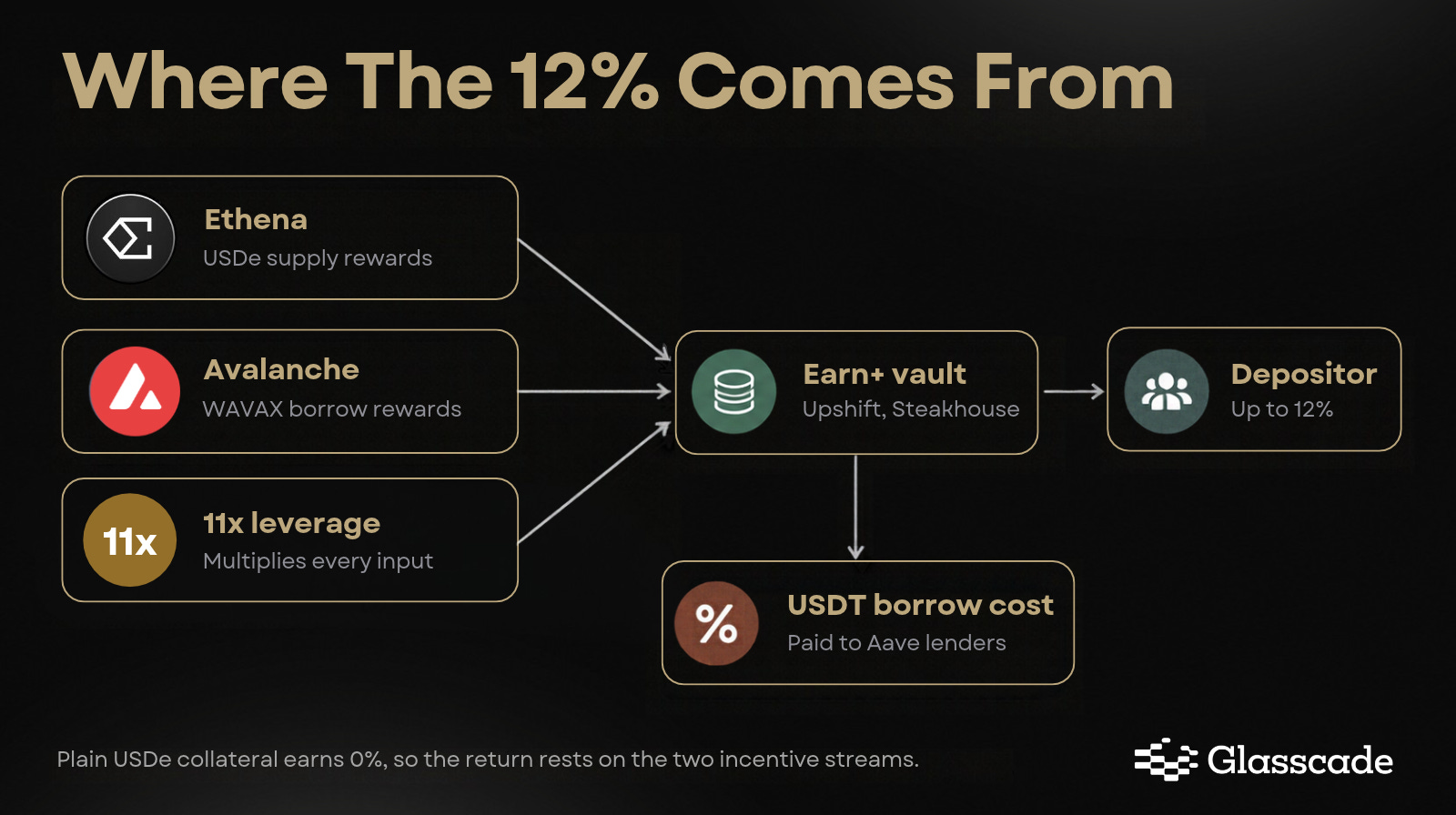
The return is built from incentives layered on top of the loop.
On the supply side, USDe rewards are distributed through Merkl, which runs Ethena’s liquid leverage program across lending markets.
On the borrow side, WAVAX rewards reduce the cost of debt, consistent with Avalanche’s commitment of up to $15M to grow Aave v4 on its chain.
The Ethena leg requires some understading. Unstaked USDe forgoes protocol yield, but the backing behind it keeps earning, and that income stays with the protocol.
It is plausible that the USDe incentive is the protocol handing that income back to the collateral in exchange for keeping the supply in circulation. Ethena is printing anything to pay 12%; and could be redirecting revenue it would otherwise keep, while Avalanche covers part of the rest.
That keeps the product cheap to run at its current size, but it also leaves the 12% unusually sensitive to inputs Ethena does not fully control.
Leverage Cuts Both Ways
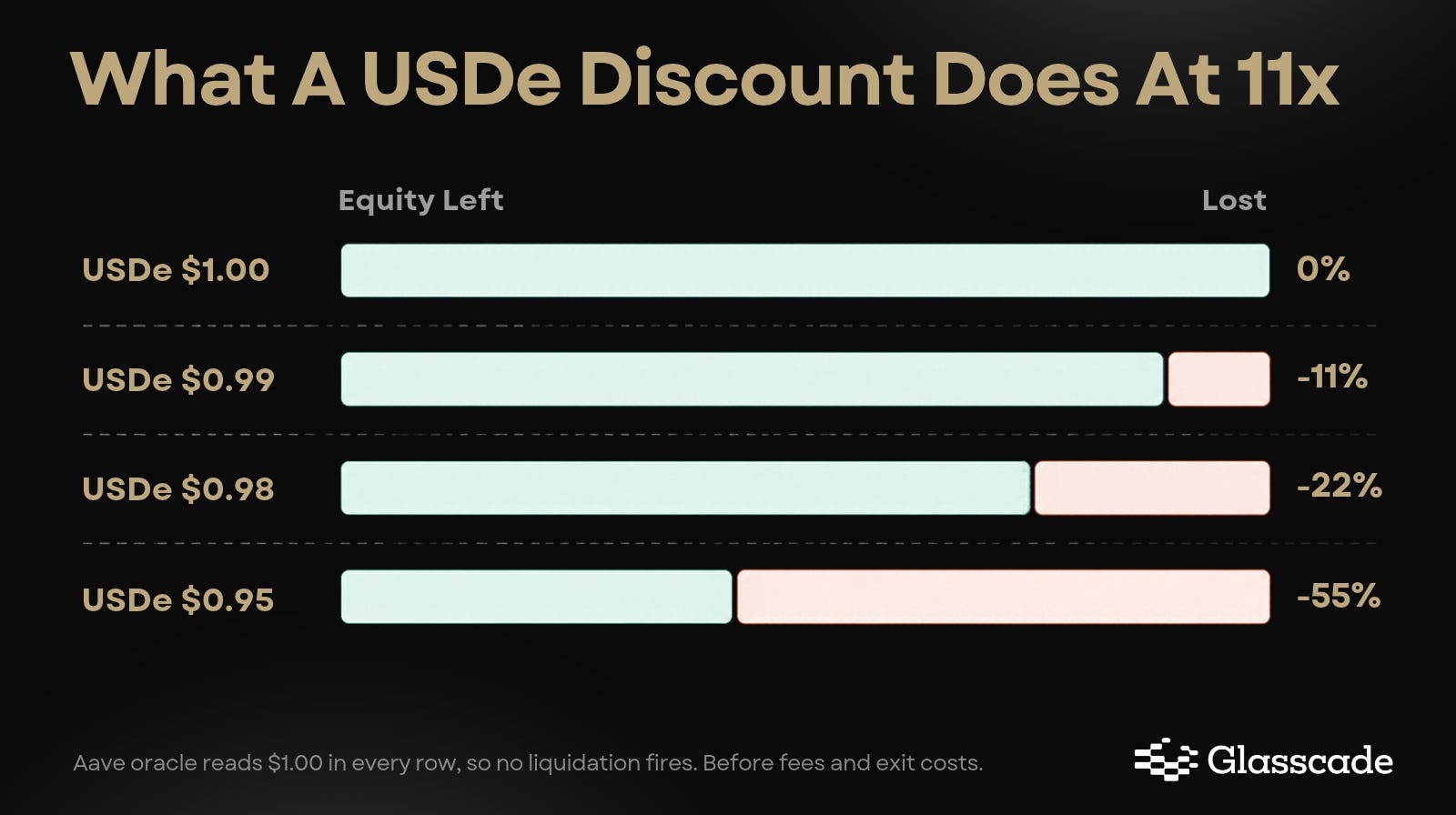
At 11x, every input to the trade is magnified, not only the reward:
Borrow cost → a 1% rise in USDT rates removes roughly 10% of annual return
Incentives → a cut to supply-side rewards exposes the negative carry underneath
Peg → a 1% USDe discount wipes about 11% of depositor equity, and a 2% discount about 22%
The borrow-rate risk compounds with size, because every new dollar in Earn+ adds USDT demand on the same market, raising utilisation and the rate the vault pays.
Past a certain scale, the product squeezes its own spread. The oracle adds another risk → the USDe price feed on this Aave market follows USDT, so a USDe-only depeg would erode equity without triggering liquidation. That delays recognition of a loss rather than removing it, and while users carry the loss under the vault’s terms, the reputational cost would land on Ethena Pay.
With the mechanics in place, let us look at what this does for the buyback.
Supply Without Revenue
The fee switch approved in September routes 95% of the Foundation’s net revenue from Ethena’s core business lines into ENA purchases, switching on once USDe’s 14-day average supply reaches $7.5B. As we covered in our USDe piece, supply stood at ~$4.54B, leaving a gap of close to $3B.
Earn+ touches that case 2 ways:
1) On supply, it helps at the margin
At full capacity, $4.5M of deposits looped 11x is roughly $50M of USDe held as collateral, under 2% of the gap to the first tier.
Our Whitelabel piece showed that crossing a tier reprices Ethena’s entire revenue base and is worth more than any single revenue line, so marginal supply is not worthless, and while Earn+ at its current cap will not close that gap alone, it adds supply that Ethena Pay may not otherwise hold.
2) On revenue, it helps even less
Buybacks are funded from net revenue rather than supply, and annualised USDe fees ran at about 5.3% of supply in September.
If the incentive paid on looped USDe roughly matches what the protocol earns on its backing, that supply nets close to zero for the buyback pool, moving the trigger closer while leaving the pool almost unchanged.
Looped USDe is the most mobile supply Ethena has. It carried the majority of the October 2025 peak near $14.7B and left first in the unwind to about $6.4B, and the 7% slip in the month after ENA incentives ended this September showed the same behaviour at a smaller scale.
A trigger built on loop demand switches on in good funding markets and off in bad ones, the opposite of the steady bid the fee switch is designed to create.
Another One In The Same Lane
At the level of intent, Earn+ bears a resemblance to Plasma One’s playbook, using above-market yield to buy distribution for a dollar product. The playbook provided some insights on product usage: of roughly 55,282 activated users, only about 7,126 used the Earn product, around 13%.
That said, Earn+ differs in some important ways. A $4.5M cap is rather small compared to billions, and no new ENA is printed to fund it, since ENA rewards for USDe holders ended in September. This means the cost is recycled yield plus a third party’s budget rather than dilution. The direction is also towards wallet share inside a card app rather than chain TVL since Ethena is not a chain.
The worst case scenario is if Earn+ draws the largest balances away from the spend-linked reward, Ethena Pay could end up paying users to save, when its value to ENA comes from them spending.
A Well-Sized Growth Lever
The economics work in Ethena’s favor.
It gives users a compelling reason to bring more dollars into the app, it is funded largely by yield the protocol already earns rather than new ENA emissions, and the $4.5M cap keeps the leverage risk contained while the team learns what demand looks like. Every dollar deposited also lands as USDe, so the feature adds to the supply base that moves the fee switch closer.
The timing gives us reason to be constructive.
Ethena Pay is still working through a waitlist of more than 10,000 against roughly 1,400 active users, so Earn+ arrives while the top of the funnel is still filling, and a 12% rate is a sharper hook for that waitlist than cashback alone. As the rollout widens, we expect the signals that matter to follow:
Cap raises that fill without a higher incentive
Ethena Pay balances and card spend that keep growing alongside the vault
Room for Ethena to taper the USDe incentive as deposits settle.
If that plays out, Earn+ becomes the cheapest acquisition channel Ethena Pay has, turning high-yield savers into card users and feeding the revenue our Pay model already shows can carry real weight toward ENA buybacks.
The supply it adds is small today, but each cap raise works both levers at once: more USDe in circulation, and more users inside an app built to get them spending.
The information contained in this report and by Glasscade and related affiliates is for general informational purposes only and is not intended to provide legal, financial, or investment advice. The report should not be construed as an offer or solicitation to buy or sell any security, token, or financial instrument and does not represent any recommendation or endorsement of any investment or financial product or service. Glasscade and related affiliates are not registered as a securities broker-dealer or an investment advisor in any jurisdiction or country.
Subscribe to Glasscade to receive valuable insights on stablecoin cards, neobanks, and onchain FX.