

A breakdown of Plasma One's growth: where the volume came from, why a returning-user base is forming while the chain around it drains, and the specific metrics that decide whether it lasts.
When a chain loses most of its stablecoin supply, the market usually stops paying attention.
Plasma gives us a reason not to.
Its stablecoin supply peaked near $6.35 billion in October 2025. By September 8, 2026, roughly $1.03 billion remained, a drawdown of about 84%.
Yet one consumer product on the chain moved in the opposite direction.
Across its tracked window, Plasma One’s weekly card volume rose to 359x its qualified early baseline, the fastest indexed growth in Glasscade’s tracked cohort.
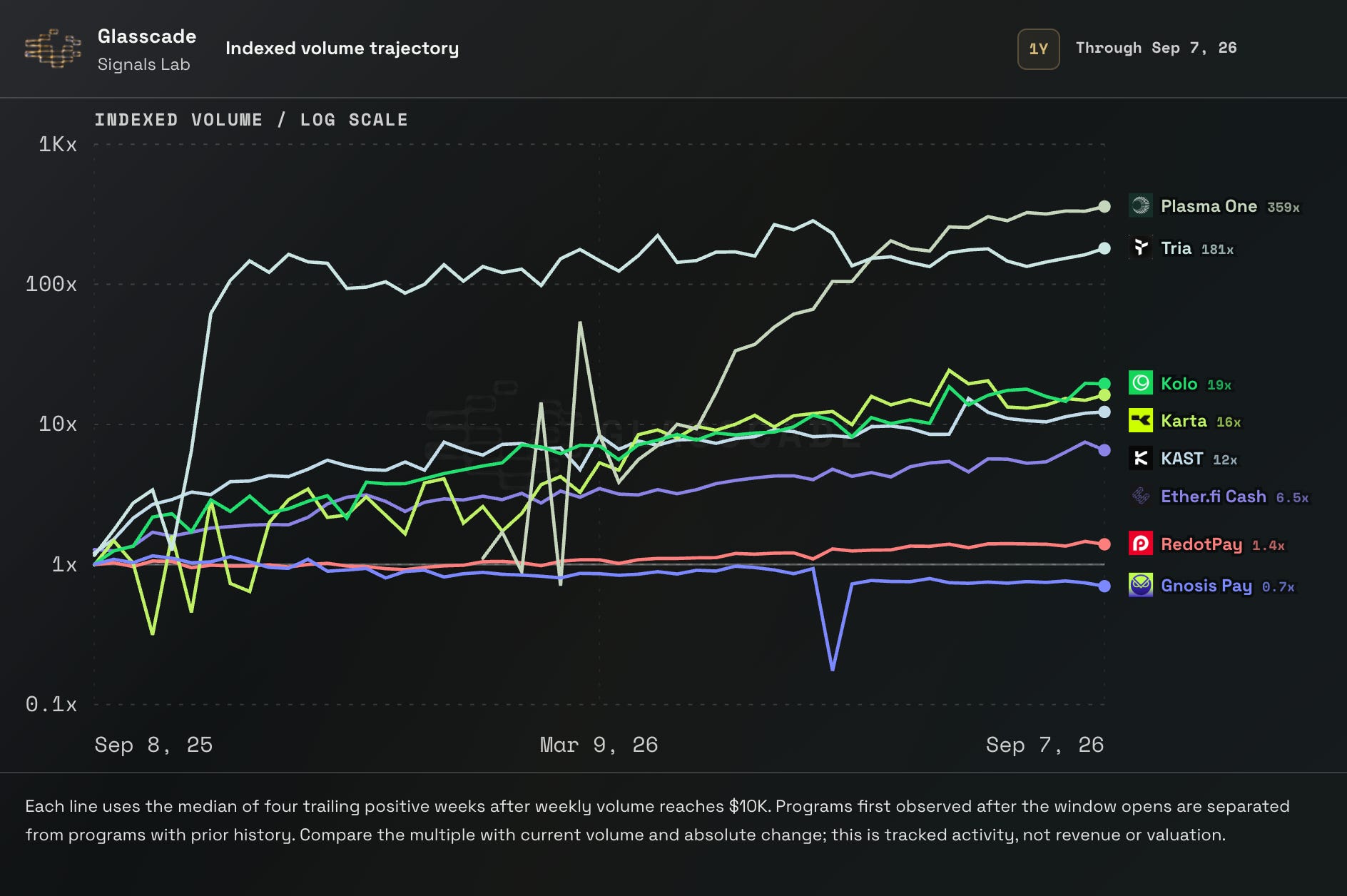
Note: The index tells us how quickly each program grew from its own qualified baseline. It does not tell us which card is largest.
Plasma One cleared roughly $19.9 million in tracked card spend during August. That is still a fraction of the monthly volume processed by the largest cards in the market. Its 359x multiple also benefits from starting near zero, as does Tria’s 181x result.
The multiple flatters newer programs by construction. The underlying activity is still difficult to dismiss.
From July to August, Plasma One’s tracked spend rose 31%, transactions rose 36%, and active tracked wallets increased almost 60%. Returning wallets represented roughly 52% of August’s active-wallet count, broadly unchanged from July.
Usage widened faster than it deepened. Volume per active wallet fell from roughly $923 to $758, while transactions per active wallet declined by around 15%. The average tracked event also slipped from approximately $139 to $133.
Plasma One is adding wallets and transactions quickly. The average wallet is not becoming more economically valuable at the same rate.
That makes the divergence more interesting. Broader stablecoin supply left Plasma, but a consumer product on the same chain continued accumulating card activity.
The Plasma One Stack
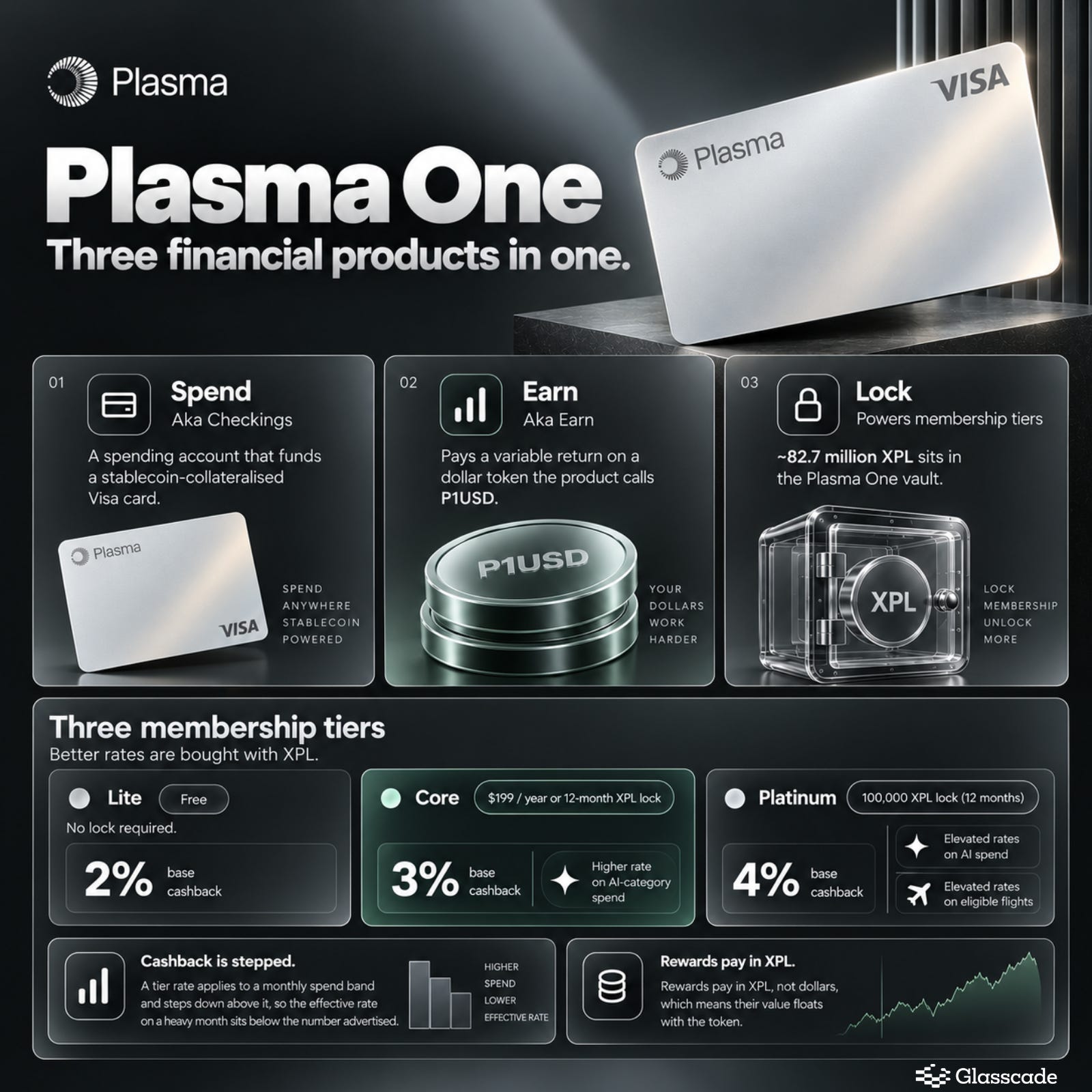
Plasma One is three financial products in one:
1) A spending account aka Checkings, that funds a stablecoin-collateralised Visa card
2) A yield account aka Earn, paying a variable return on a dollar token the product calls P1USD
3) A lock, that gates membership tiers and their rewards, with ~82.7 million XPL sits in the Plasma One vault
A user who wanted those three things a year ago assembled them across a wallet, a lending protocol, and an exchange, and Plasma One folds them into a consumer surface like a neobank.
The lock is not incidental to the product; it is the pricing mechanism. Membership runs three tiers, and the better rates are bought with XPL:
Lite → free, no lock. 2% base cashback.
Core → a $199 annual fee or a twelve-month XPL lock. 3% base, with a higher rate on AI-category spend.
Platinum → a 100,000 XPL lock for twelve months. 4% base, with elevated rates on AI spend and eligible flights.
Cashback is stepped - a tier rate applies to a monthly spend band and steps down above it, so the effective rate on a heavy month sits below the number advertised. And rewards pay in XPL, not dollars, which means their value floats with the token.
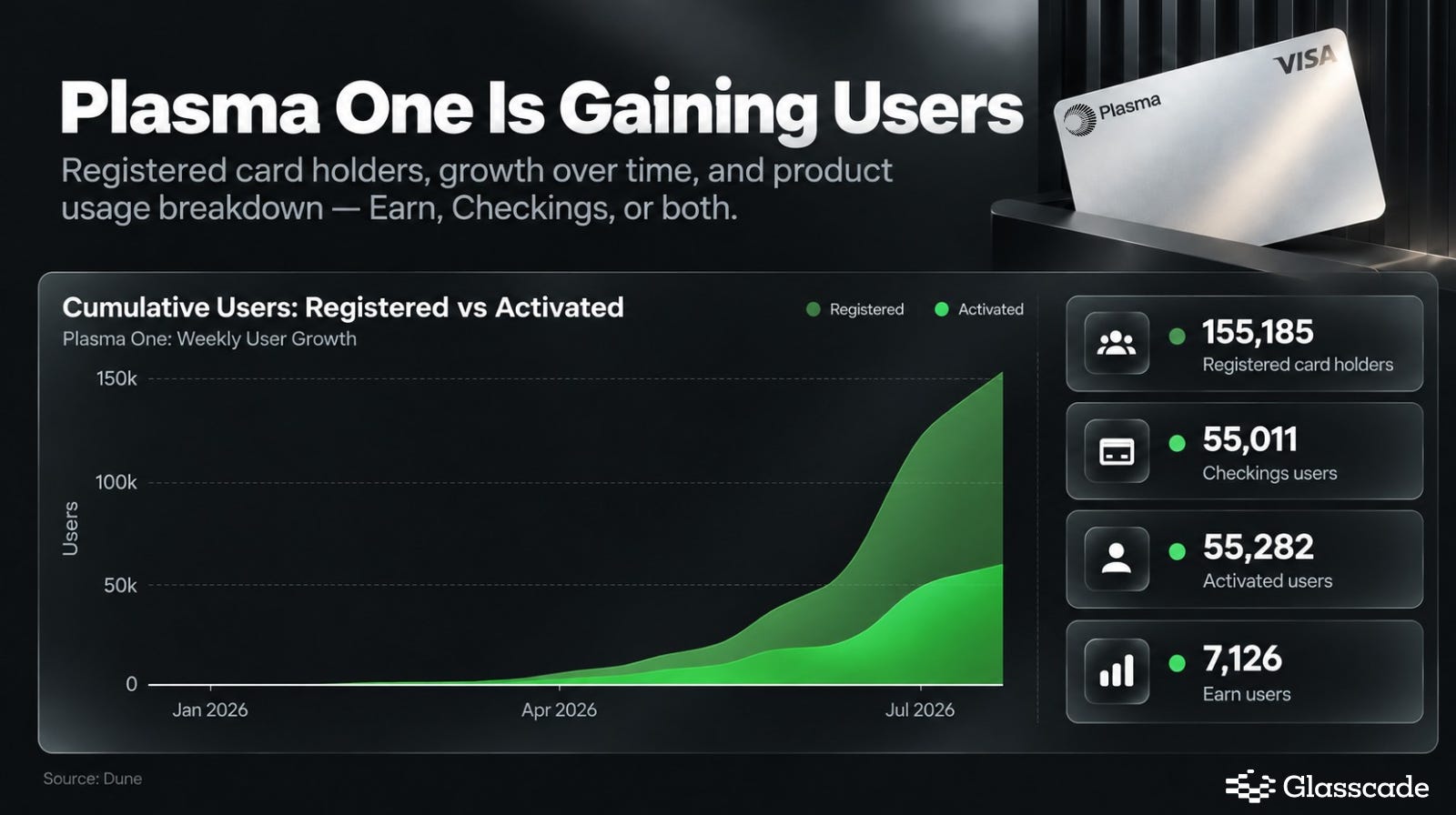
A product growing this fast offers six different numbers to quote, and they answer six different questions:
Registered card holders: 155,185
Activated users: 55,282
Checkings users: 55,011
Earn users: 7,126
Active tracked wallets, August: 26,265
Cumulative addresses, program history: 32,600
Natural instinct tells us to reach for the largest of them. The number that describes actual use sits well below the number that describes sign-ups, and the distance between the two is the product’s real position.
Roughly a third of registrations have activated, and roughly one in twenty holds a yield balance - a funnel that narrows hard at each step. That is not, on its own, a flaw. A registration is a low-commitment act and a large gap between it and use is the normal shape of a free-to-join consumer product. The gap locates the growth story precisely - Plasma One has proven it can put a card in front of people.
What the later sections test is whether the third who activated behave like customers or like sign-ups who stopped.
The Acquisition-Spending Transition
Where the growth came from is more revealing than how much of it there was. Our decomposition attributes 74% of the three-month volume increase to one factor alone: more active addresses. Frequency per address and average ticket size, between them, explain almost none of it - and over six months the ticket size has fallen sharply even as addresses multiplied.
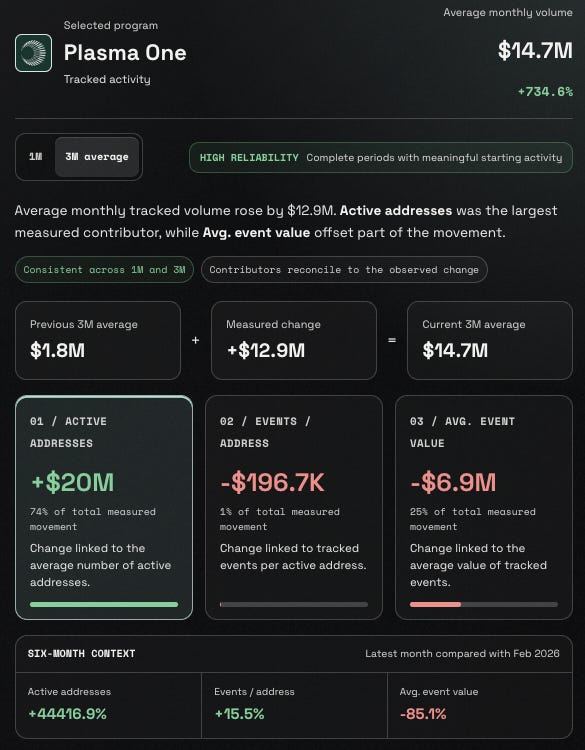
To understand a falling ticket size requires a deeper look.
A declining average event value could mean the product is losing its heaviest users and shrinking toward irrelevance. It could equally mean the base is broadening, and that the early cohort of large, crypto-native spenders is being diluted by a wider population making smaller, more ordinary purchases.
The address count data settles this.
A card bleeding its best users shows falling tickets and flat or falling addresses together. In this case, Plasma One shows falling tickets against addresses multiplying many times over. Hence it is more of a regression toward the mean as the product reaches past its earliest adopters, a broadening signal instead of concluding it as a decline.
That leaves a specific, legible profile: a card that has solved acquisition and not yet spending. That is the expected order for an early consumer rollout where the base widens before the habits deepen.
New users are comparatively easier to acquire. The test is whether they come back once the reason to arrive has been spent - but do they?
Caught your attention yet? Subscribe to Glasscade to not miss out on these insights.
The Base Is Compounding
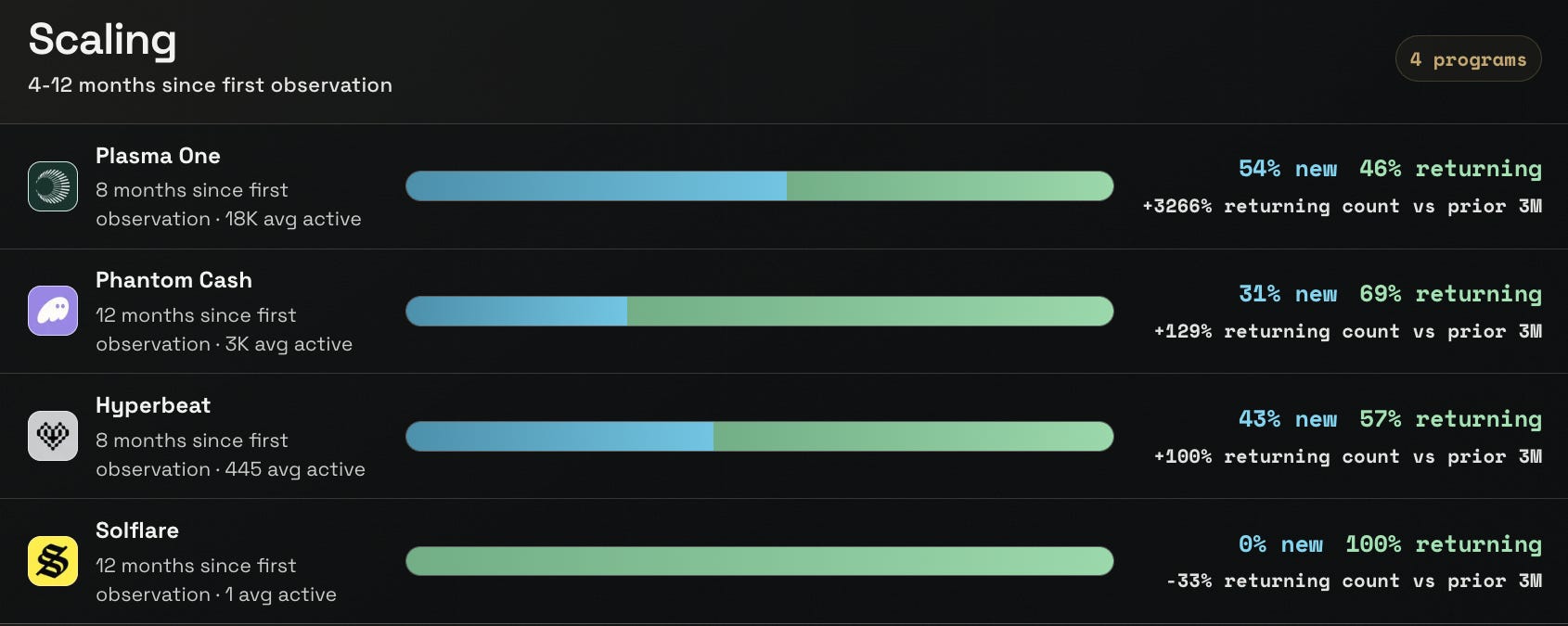
Among the card programs which are categorised in the Scaling phase, the 46% returning share may look thin next to the others. It might even seem like a balance between new and returning users, such that one may think that Plasma One is losing its current users.
The data says otherwise. Plasma One’s returning cohort is growing several times over quarter on quarter, which is the return you cannot manufacture with a signup incentive.
Seen from another angle, the top of its funnel is filling fast enough to keep new users a near-even portion of the base, which means the momentum of user acquisition is still very strong.
This combination is an encouraging sign for a card program who wants to establish its credibility in the space.
The Money That Stayed
Over the last months, the chain’s largest DeFi venues have contracted across the board. Talk about lending, yield, and DEX liquidity - all went lower, while the one line moving up the rankings is the card.
Caveat here, the contrast is not merely that the card grew and the rest did not, but that the two are exposed to different demand entirely.
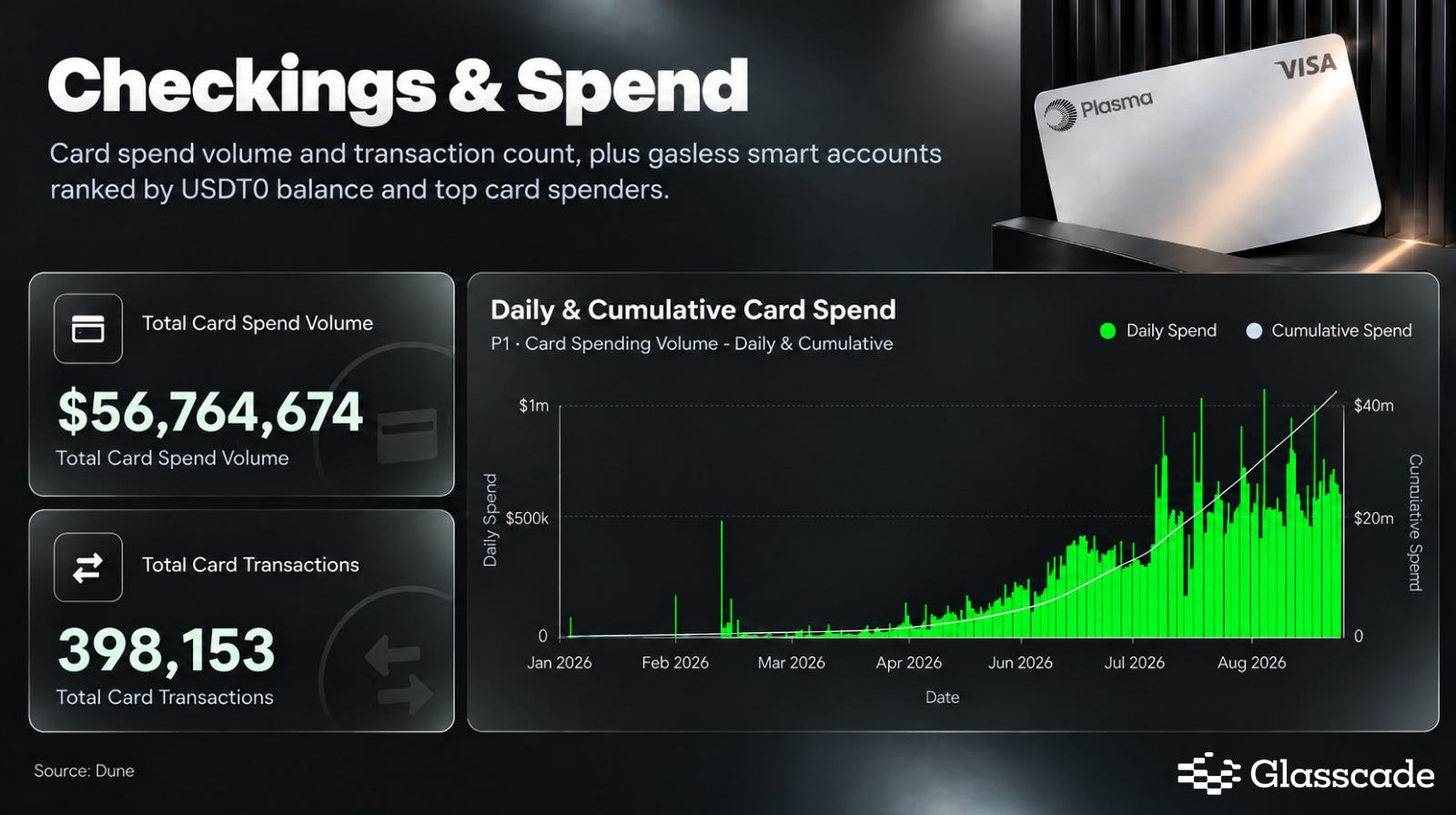
The shape of that curve is the argument the aggregate TVL number cannot make. Launch capital and card demand were never the same money. The billion-plus that filled Plasma’s vaults arrived through three engineered channels, none of them under any obligation to stay:
A pre-launch deposit campaign
An oversubscribed public token sale
An exchange yield program
Though most of it left, the spending line kept climbing after, which is why the card appears to be what the chain actually retained.
The drain may also be finding a floor, though that is worth watching rather than banking: stablecoin supply has ticked up over the past week and DEX volume has recovered off its lows. Against a year of contraction, we’ll need the few green weeks to confirm a stabilisation.
What To Watch For Plasma One
Plasma spent its launch trying to prove that a chain narrowed to one job of moving stablecoins could hold liquidity on its own merits. The current liquidity trend seems to say no. Meanwhile, Plasma One is testing a different and harder version of the same bet: that the demand a chain cannot rent, it can build, one card and one returning user at a time.
The evidence so far is a base that is real but still needs more work - a large top of funnel, a returning cohort compounding underneath it, and a spending habit that has not yet deepened to match.
The numbers that will settle it are already live on our dashboard, and they are the ones we will be reading into next quarter:
Can registrations keep converting or stall?
Will the spending frequency and returning share climb as promotional rewards cool - turning acquisition into spending?
Does native-USDC funding (when live) for the product move volume higher?
Our take is that Plasma One is the most convincing thing built on Plasma this year, and only time will tell if it will be a durable product. A continued growth rate would give higher probability of it becoming a signature product of Plasma. If it stalls, it joins the long list of consumer products that acquired users faster than they gave them a reason to stay.
The information contained in this report and by Glasscade and related affiliates is for general informational purposes only and is not intended to provide legal, financial, or investment advice. The report should not be construed as an offer or solicitation to buy or sell any security, token, or financial instrument and does not represent any recommendation or endorsement of any investment or financial product or service. Glasscade and related affiliates are not registered as a securities broker-dealer or an investment advisor in any jurisdiction or country.
Subscribe to Glasscade to receive valuable insights on stablecoin cards, neobanks, and onchain FX.