



Brief intro: Everyone knows Ether.fi as a restaking protocol. Fewer have noticed that its card has been compounding the entire time the staking balance sheet drifted off its highs. At Glasscade, we break down what the data says about how Ether.fi Cash grew, and why it reads like a payments product than a sidekick.
Etherfi is known as a restaking protocol, with billions in deposits, a token, and a place near the top of the DeFi TVL tables, but that description is starting to lag the business it actually runs.
The staking balance sheet has had a soft year, drifting off its 2025 highs and only recently turning back up. Using that headline alone, it is easy to say that Etherfi is in retreat. Yet, a revelation of layers shows where the growth went - Etherfi Cash.
Across 3 and 6 months of Glasscade data, Etherfi Cash grew almost entirely by getting used more often, not by getting used for larger purchases. On a 3-month average, monthly tracked volume rose 40.5%, from $69.6M to $97.8M.
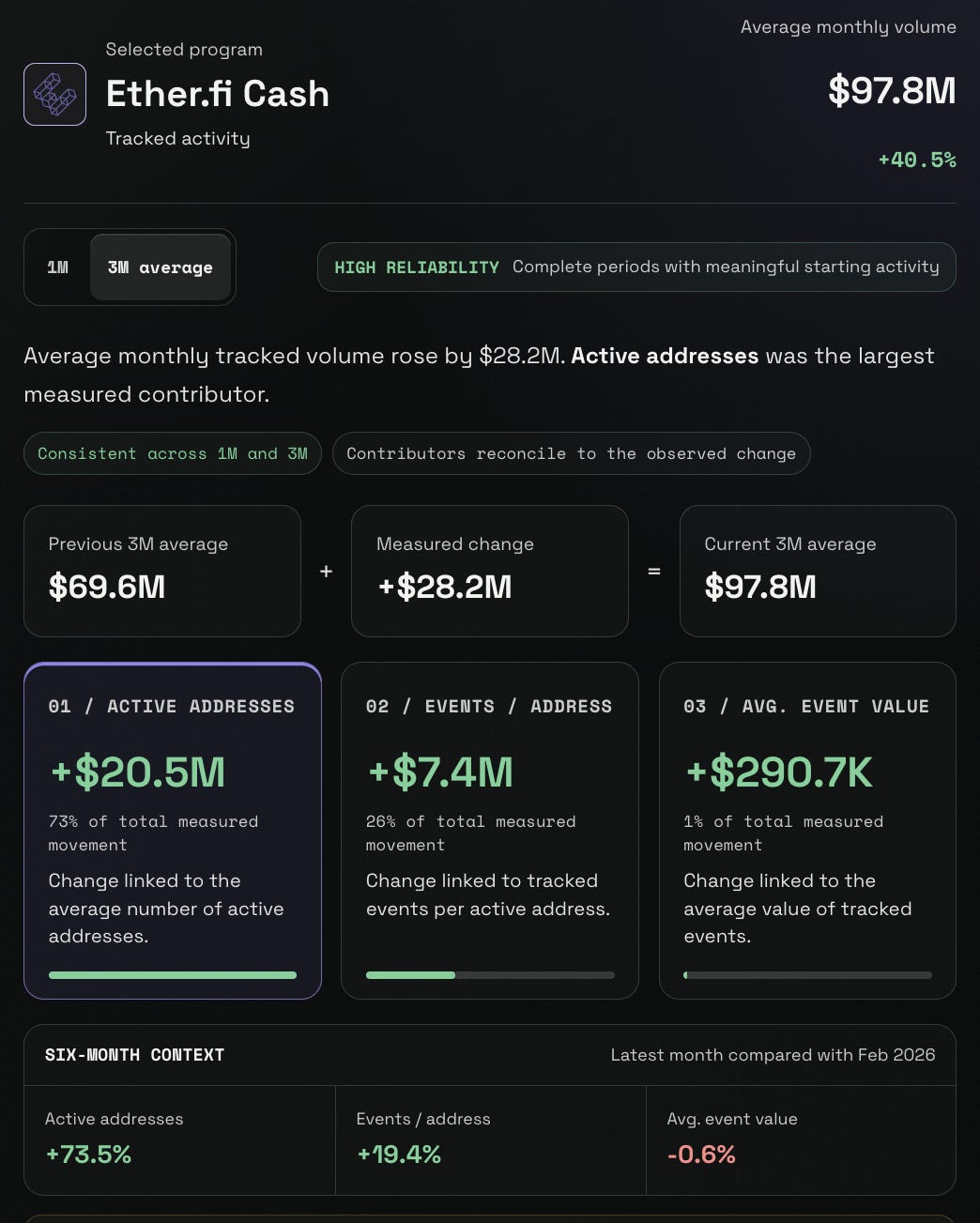
The growth came from more people using the card and using it more often, while the average amount they spent per purchase barely changed.
That is the behavioral signature of a payments product people reach for out of habit, and it is the reason the card deserves to be read as a business in its own right.
Where Cash Sits Among Tracked Cards
Every tracked card program is placed against two axes, one for how large the average purchase is and one for how often each active address transacts, and once they are plotted the programs separate cleanly into the ones whose activity looks like everyday spending and the ones built on a few large transfers.

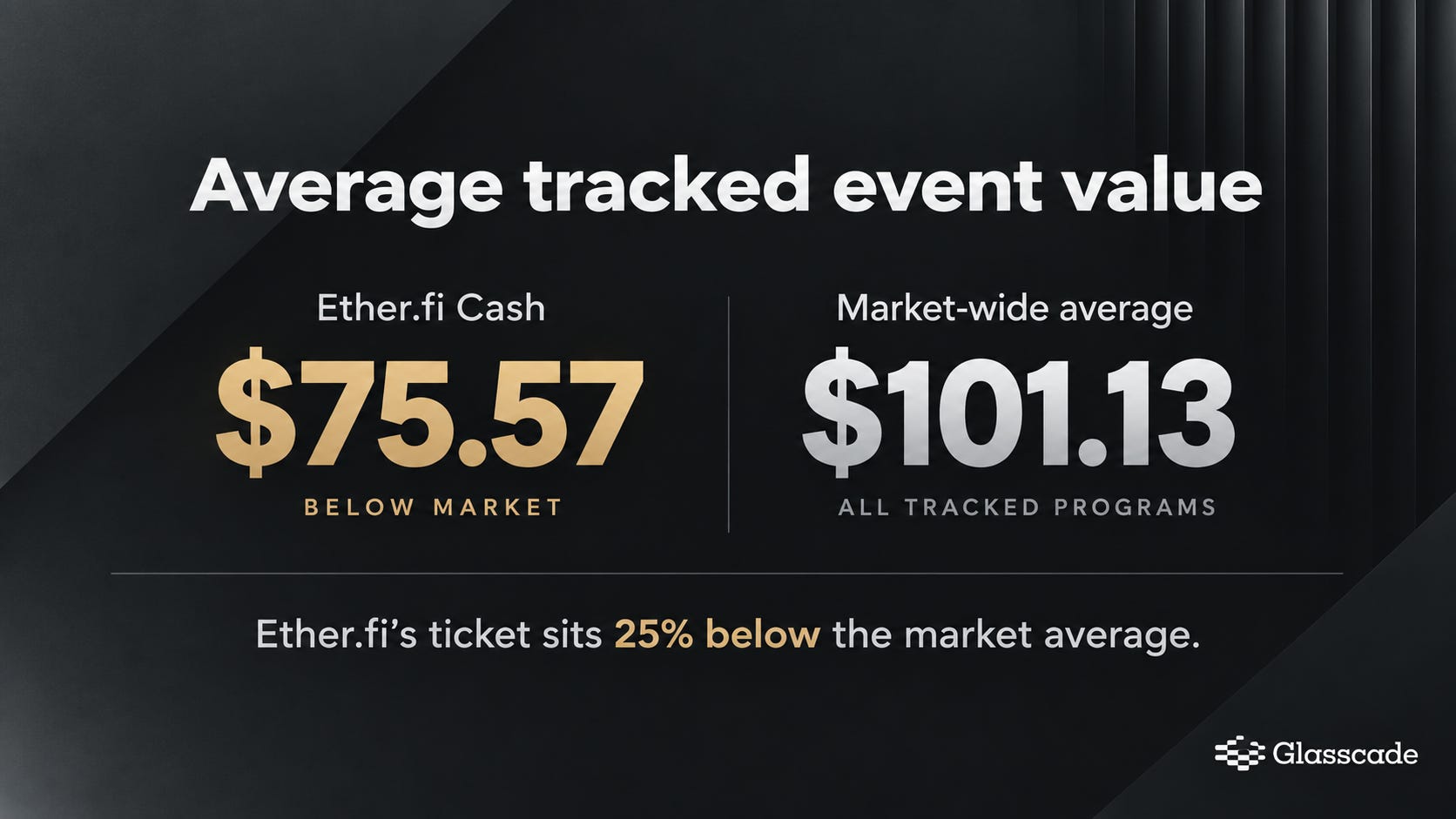
Etherfi Cash lands exactly where you would want a consumer card to land, in the corner where tickets are small and frequency is high, and its average tracked event runs below the market-wide average.
In Tradfi terms, this displays similarity to the debit-card interchange profile, many small authorisations, than to the charge-card profile of infrequent large balances.
Scale has followed the behavior rather than the other way round. Etherfi Cash is the second-largest tracked program by volume across every window we measure, 7D, 30D and cumulative, and it sits behind only RedotPay while ranking ahead of every other card in the set.
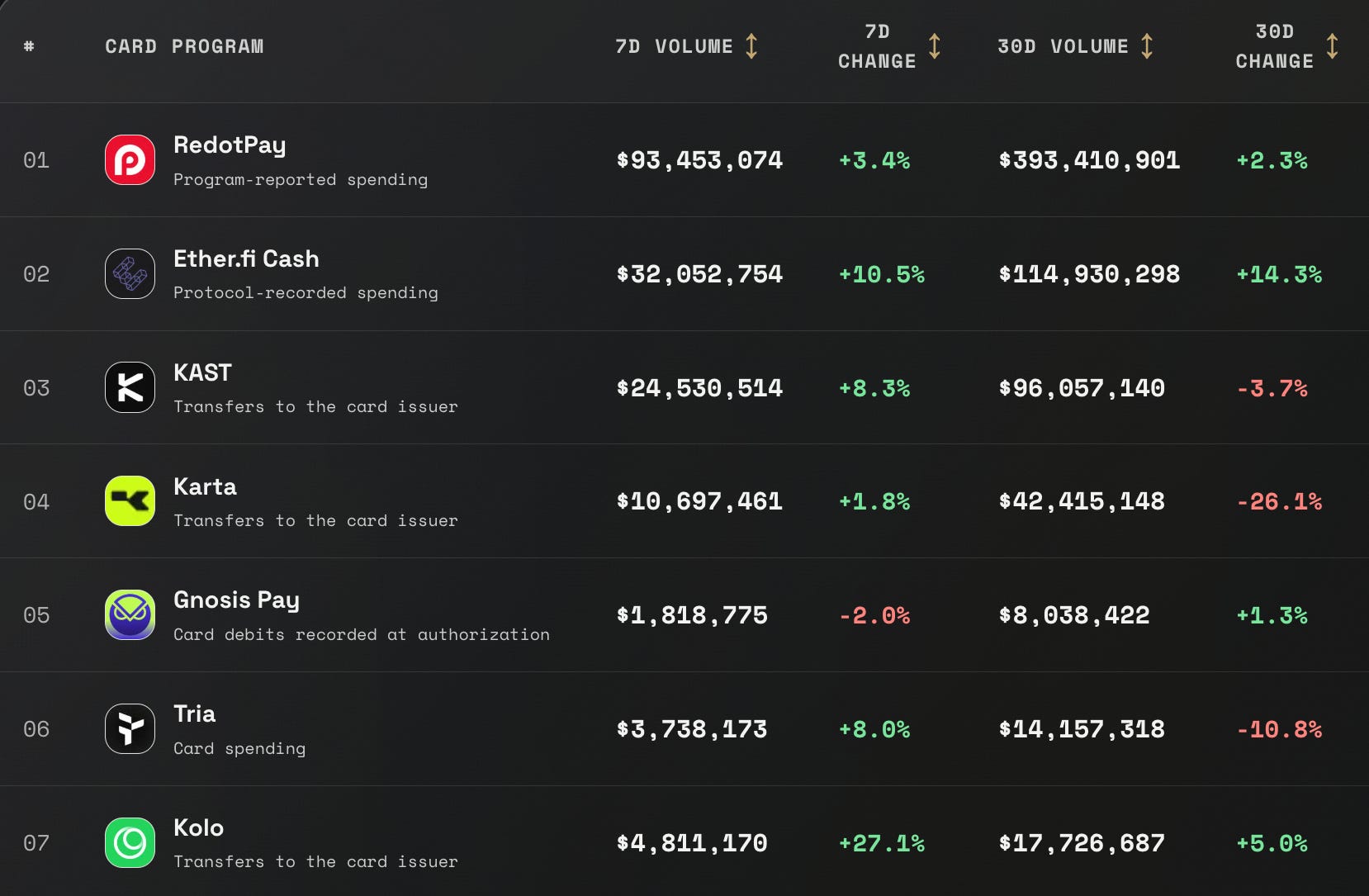
The ranking is not the main focal here, because plenty of programs can buy their way up a volume table for a month.
What sets Etherfi apart is how it climbed, since the growth traced back to more active addresses and higher frequency rather than to inflated ticket sizes, evidence that the spending is organic rather than manufactured by incentives.
Among the established card programs, Etherfi is one whose numbers look most like a card people simply use, and it manages that while still onboarding new addresses every month, a combination that most of the field cannot boast of.
Caught your attention yet? Subscribe to Glasscade to not miss out on these insights.
The Returning-Count Trend
Growth built on new addresses raises the obvious question of whether those people come back or whether the program is renting one-time signups, and the address lifecycle mix is where that question gets answered.
Etherfi Cash sits in the Established band, more than 22 months since its activity was first observed and averaging around 41,000 active addresses, which places it among the mature programs rather than the launch-phase ones.
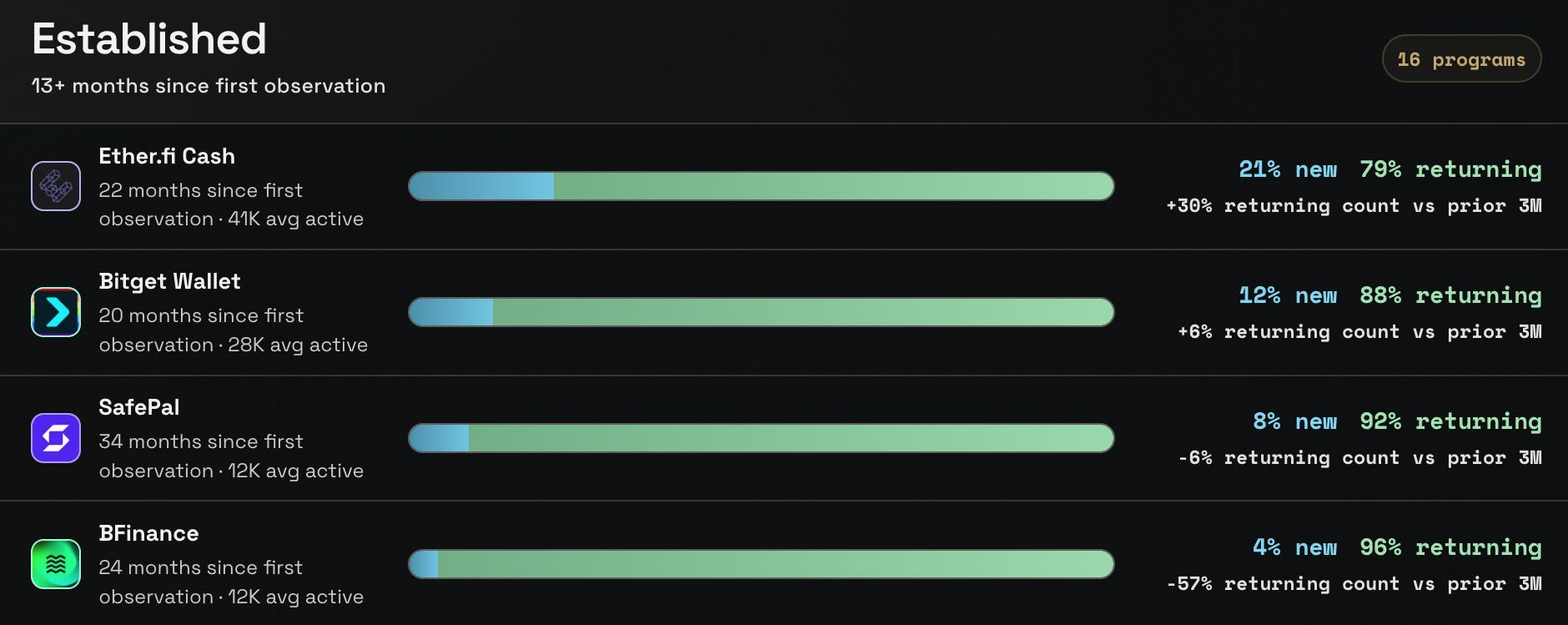
At first glance, Etherfi Cash’s 79% looks less sticky. On second glance, the returning-count trend inverts that perspective.
Those older programs are holding a high returning share while their actual returning counts flatten or fall, whereas Etherfi Cash is lifting its returning count by roughly a third against the prior 3 months.
Even though Etherfi Cash is established, it still continues to have growth momentum rather than leaning towards stagnancy.
The Two Engines At Different Speeds
The card is easier to understand when it compared against the liquid staking model it grew out of, because the two have spent the year moving in opposite directions.
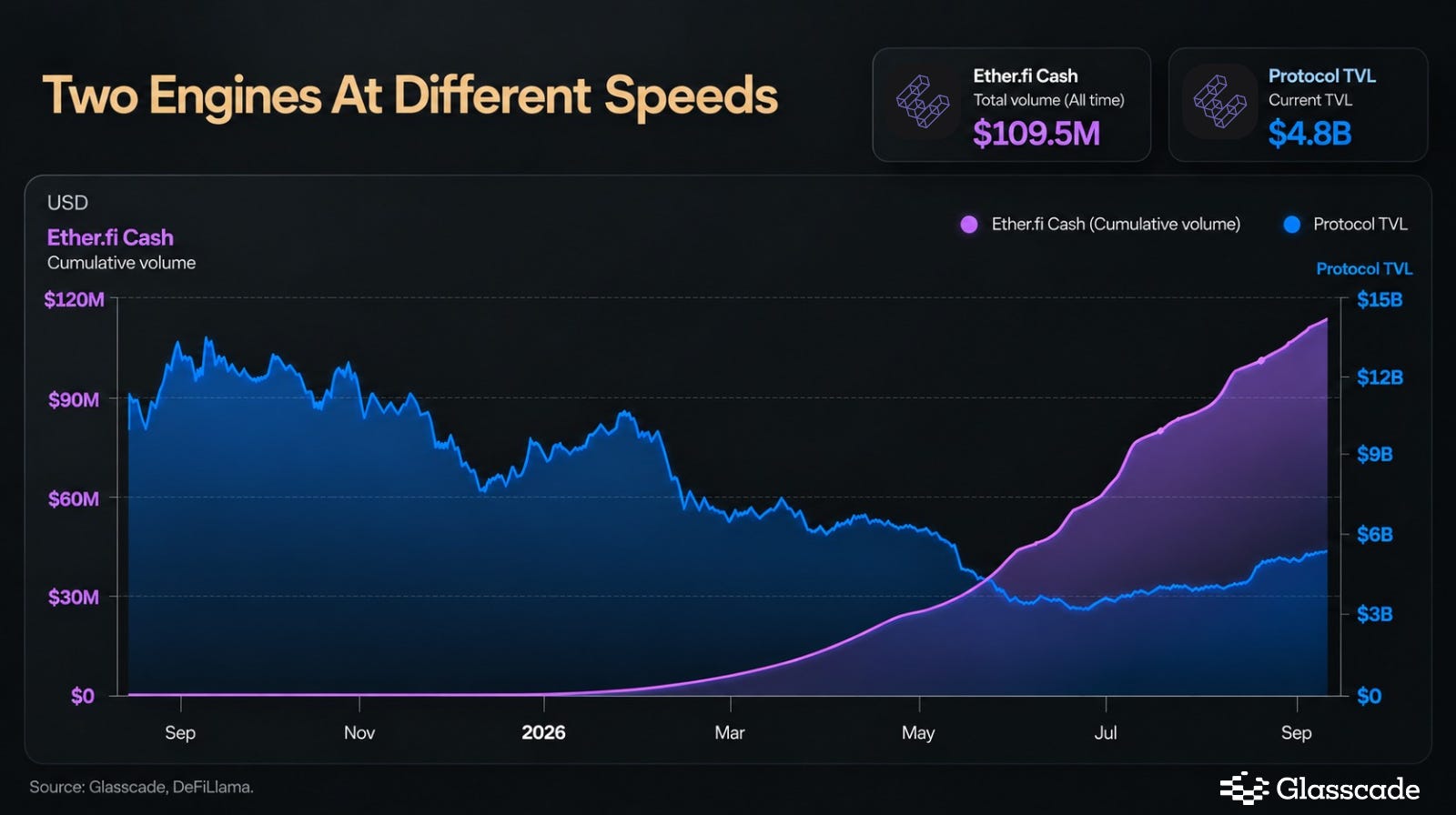
The temptation is to link them, to cast the card as the reason the balance sheet is healing or the balance sheet as the fuel behind the card.
Instead, what it supports is decoupling. The card grew across a stretch when the TVL that supposedly anchors the protocol was declining, and a payments business that keeps expanding regardless of what the deposit base is doing is worth considerably more, strategically, than one that merely tracks it.
The Card As An Entry Point
We believe none of this stays as a card story for long because Etherfi’s summer release extended the account well past payments, adding tokenised equities, precious metals, an integrated Aave market on Optimism, and a widened set of transfer and fiat rails.
All these features are wrapped in an interface aimed at new users who are unfamiliar or have never touched restaking. The card has become the wedge, the familiar object at checkout, and behind it sits a self-custodial account that increasingly resembles a full financial product.
The frequency data is what makes that reframing credible because an account is only a daily habit if something inside it gets used daily, and a card that clears more than a million tracked events a month, on a rising events-per-address count, is the most plausible candidate for that habit anywhere in the Etherfi stack.
At Glasscade, here are what we will keep watching over the coming quarters:
Can the payments layer pull the rest of the account into daily use?
Will spending and the broader financial product stay as two separate things?
Does the address-frequency trend continue or fall off?
Etherfi built a card that grows by being used more often, sitting in the frequent-small quadrant of the tracked market, adding repeat users while the protocol’s original TVL engine spent the year in retreat.
The Etherfi Cash is no longer the accompanying and could even turn into the mainstay. From these data points, it is the part of Etherfi with the clearest claim on a user’s daily attention and fast becoming the reason to open the app.
The information contained in this report and by Glasscade and related affiliates is for general informational purposes only and is not intended to provide legal, financial, or investment advice. The report should not be construed as an offer or solicitation to buy or sell any security, token, or financial instrument and does not represent any recommendation or endorsement of any investment or financial product or service. Glasscade and related affiliates are not registered as a securities broker-dealer or an investment advisor in any jurisdiction or country.
Subscribe to Glasscade to receive valuable insights on stablecoin cards, neobanks, and onchain FX.